
Outsourcing renewal contracts this year look significantly different from how they used to. The client has stopped asking about rates. Instead, they ask why a case still takes nine days to close when no single step in it takes more than an hour.
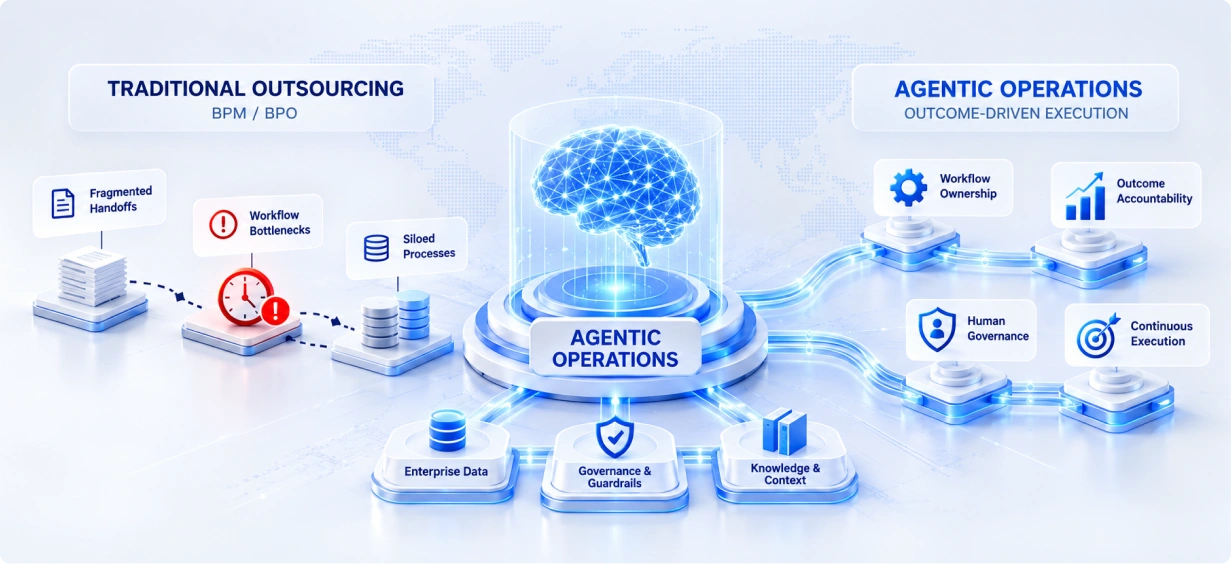
That question marks the end of the labor-arbitrage era in business process management (BPM) and business process outsourcing (BPO). The delays no longer sit inside the tasks. They sit between them, in the handoffs, and adding headcount rarely fixes that coordination gap.
Traditional BPO was built to sell labor against tasks. Agentic operations are built to own workflows against outcomes, with agents doing the repeatable work and people governing the decisions that carry risk. That is outcome-owned execution. Agents make it possible, but governance and the contract decide whether anyone actually owns the result. So, the question for COOs, CFOs, and shared-services leaders is no longer make or buy. It’s who owns the coordination of the work and who is accountable for the outcome.
The bottleneck moved from labor to coordination
Outsourcing models were built to optimize labor against SLAs: finish the work faster, keep the cost down. Buyers have moved past that brief. In Deloitte’s 2024 Global Outsourcing Survey, only 34% of organizations named cost reduction as their main reason to outsource, down from 70% in 2020. They now want speed and measurable results, which a model priced in effort was never designed to deliver.
Meanwhile, the work itself spread out. A mortgage file moves across a dozen systems and stakeholders before it closes. A healthcare denial pulls in coding, clinical documentation and payer rules. A single customer case can cross chat, voice and email in an afternoon. Each crossing is a handoff, and each handoff is a case that can wait.
Extra headcount tends to multiply those crossings. Asana’s Anatomy of Work Global Index 2023, a survey of 9,615 knowledge workers, found that 58% of the working day goes on work about work, such as chasing status, switching apps, and hunting for information. In an outsourced operation, that overhead is billable. Add seats and the client pays for more of it.
Automation made tasks faster. The workflow stayed slow.
What happens when the vendor gets faster, but the workflow doesn’t?
Most enterprises have already found out. A decade of RPA, intelligent process automation, workflow engines, analytics, and copilots made individual steps quicker. Few of those tools owned anything between the steps, which is the gap AI workflow orchestration is meant to close. The RPA bot knows the invoice was keyed; it doesn’t know the purchase order is disputed.
A screen change or a new field breaks a bot silently, and every layer added grows the maintenance burden. An exception lands in a queue with no context and waits for someone to notice it. People end up as the integration layer, copying data between systems, chasing approvals, and that helps explain why cycle times can stay stubborn even as automation budgets grow.
It also explains why “isn’t this just RPA with a new name?” is a fair question. The answer depends on who coordinates the work and who owns the result.
Agentic operations change who owns the workflow
Traditional contracts were written around activities: process this claim, key this invoice, route this ticket. Outcome-owned execution is written around the result those activities were meant to produce. That is the real change agentic AI brings to BPO, more than any single tool.
| Dimension | Traditional Outsourcing | Agentic Operations |
|---|---|---|
| Unit of Delivery | Task or activity | Measured business outcome |
| Scaling Mechanism | Hire more people | Configure and extend agents |
| Billing Basis | Per seat, hour, or transaction | Outcome-based, tied to agreed metrics |
| Human Role | Executes the process | Governs risk, exceptions, and policy |
| Cost Trajectory | Roughly linear with volume | Grows far more slowly than volume |
The difference is redesign, not tooling – PwC’s study substantiates
Redesign is what makes the difference. PwC’s 2026 AI Performance Study of 1,217 senior executives found that 74% of AI’s economic value is captured by just 20% of organizations, and those leaders were twice as likely to redesign workflows around AI rather than add AI tools to existing ones. For agentic AI in business process management, the implication is that an agent added to an unchanged workflow is unlikely to deliver what a redesigned workflow can.
Autonomy without governance just moves the risk
More autonomy does not mean less human involvement. It means deciding, decision by decision, how close a person needs to be. Three levels cover most workflows.
| Oversight Level | What the Person Does | Typical Use |
|---|---|---|
| Approval (Human-in-the-Loop) | Approves before the agent acts | High-risk, regulated, or irreversible decisions, such as a final credit decision |
| Supervision (Human-on-the-Loop) | Monitors the agent and can intervene while it acts | Medium-risk decisions governed by clear policies, such as refunds above a threshold |
| Governance (Human-over-the-Loop) | Sets policies, audits outcomes, and adjusts guardrails | Low-risk, high-volume work, such as document classification |
Outcome ownership depends on getting this right. Choosing the level is the easy part. The hard part is proving that the chosen level is appropriate, controlled, and auditable.
Programs that skip that work tend to stall. Gartner predicts that more than 40% of agentic AI projects will be canceled by the end of 2027, citing escalating costs, unclear business value, and inadequate risk controls.
Unclear value and weak controls both trace back to decisions made before an agent goes live: what the outcome is, how it is measured, and where the agent’s authority ends. Well-governed deployments tend to converge on the same escalation pattern, regardless of function.
Guardrails decide the path; the log closes the loop
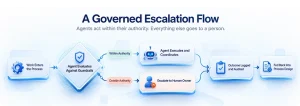
In a governed agentic operation, the work is checked against the agent’s guardrails first. Within its authority, the agent executes and coordinates the downstream steps. Outside it, the case goes to a named human owner with full context. Both paths end in one audit log, which feeds back into process design, so a recurring exception becomes a new rule or a tighter guardrail.
If an agent makes the decision, who owns the consequence?
Before a CFO or general counsel, this is a critical ask before anything else. In a seat-based contract, the answer was simple. The provider supplied people, and the client owned the result. In an outcome-owned model, where agents do the work, that split has to be rewritten.
| Ownership Area | Responsibilities |
|---|---|
| Provider Owns |
|
| Client Owns |
|
| Jointly Owned |
|
If accountability for the outcome isn’t reflected in the contract, the arrangement remains closer to managed effort than to outcome ownership.
From staffing commitments to outcome commitments
Traditional BPO asks how many people a provider will supply. Agentic outsourcing asks what business results the provider will own. If the technology changes who performs the work, it eventually has to change how the work is contracted.
The metric has to be one that the business already tracks: first-contact resolution and cost per resolved case in customer operations, days from application to decision and touches per loan file in mortgage, denial recovery and days in accounts receivable in healthcare, quote-to-cash cycle time and revenue leakage recovered in revenue operations. Pricing should say what happens as automation increases.
A client paying per seat has no reason to welcome a faster agent, but a client paying per resolved case does.
What changes in regulated industries
Healthcare and mortgage raise the bar. A provider whose agents touch protected health information has to operate under HIPAA, sign a business associate agreement, and meet the client’s data residency requirements.
In lending, the CFPB’s Circular 2022-03 states that creditors using complex algorithms must still give applicants an accurate statement of the specific reasons for an adverse action, so the record has to show why an agent flagged, routed, or held a file. In both industries, more decisions sit at the approval level, and the contract should say which ones.
Where workflow ownership becomes practical
Outside mortgage, three other functions show the same pattern in Flatworld.ai’s delivery work.
Customer operations: closing the loop, not just answering the question
A support bot that answers a refund question still leaves someone to process the refund. Telenok carries conversations across email, chat, voice, WhatsApp and SMS through to the backend action that closes them, such as a return, a CRM update or a claim, and hands complex cases to a person with the full history attached. Telenok reports automating up to 80% of queries, with deployments live in five to six weeks.
Healthcare revenue cycle: working the claims that matter first
A biller working the denial queue in arrival order spends the morning on low-value claims. Agents can rank claims by recovery likelihood, coordinate prior authorizations and recommend corrective action. In a production deployment of Curaide at a PE-backed home health company, the denial rate fell from 4% to 2.75% and days in accounts receivable came down by three to five days.
Revenue operations: owning the delay between teams
Who owns the delay between two automated systems? In revenue operations, usually nobody. Deals stall between sales, finance, and delivery until someone notices. SalesDen starts with the most basic gap, the roughly 17 minutes a rep loses per lead switching between CRM, email, dialer, research, and task tools, and pulls that work into one system where follow-up can be triggered instead of remembered.
Not every workflow should become agentic
Agentic AI for enterprise operations works best where volume is high, decision patterns repeat, outcomes are measurable, and coordination overhead is expensive. It fits poorly where every case is genuinely unique, where decisions rest on subjective judgment, where the process changes every month, or where a single error is catastrophic.
The economics follow the same line. Agents bring their own costs: model inference, integration, monitoring, evaluation, security, and the people who oversee them. Those costs are largely fixed, so agentic execution beats labor when volume is high enough, and the coordination it removes is expensive enough.
When agents take over coordination, capacity can grow without a matching increase in headcount, and the cost of each additional case can fall. On a small or chaotic workflow, the fixed costs can outweigh the savings.
Agentic programs also fail for familiar reasons: a poorly defined process, poor data, fragmented system access, unclear decision rights, misaligned incentives, or weak governance.
The readiness check that catches most of them before a pilot starts
| Readiness Dimension | Ready Signal | Not-Yet-Ready Signal |
|---|---|---|
| Process Visibility | Steps, handoffs, and exceptions are mapped | Process knowledge sits mainly with individuals |
| Data Access | Systems expose clean data through APIs | Data lives in spreadsheets and email threads |
| Governance Clarity | Approval authority is already defined | Decision rights are informal or contested |
| Exception Patterns | Exceptions follow recognizable patterns | Exceptions are highly case-by-case |
| Sponsorship | Leadership backs process redesign, not just new tools | Automation is framed purely as cost-cutting |
A workflow that is weak on governance clarity should be fixed first, however ready everything else looks.
A practical path from pilot to workflow ownership
Moving from a pilot to workflow ownership is a BPM transformation in its own right, and it follows a clear sequence of steps:
Map the workflow: Document how work actually flows, including exceptions that existing documentation misses.
Identify friction: Find where delays and rework concentrate.
Set governance: Define decision rights and oversight levels before any agent goes live.
Deploy within clear boundaries: Start with one bounded workflow and run a pilot measured in weeks, not quarters.
Measure before scaling: Track cycle time, rework, cost-to-serve, and exception rates. Scale only when the results support it.
What happens to the people?
Boards and employees will ask, and a vague answer reads as evasion. The work that shrinks is predictable: repetitive processing, manual data entry, routine quality checks, and queue monitoring.
The work that grows is less obvious. Someone has to design workflows, handle the exceptions agents escalate, supervise agent performance, set domain policy, and run governance reviews. Process analytics and AI operations become standing roles rather than projects.
Those roles need people who already understand the work, which is why the institutional knowledge inside today’s operations teams matters more in an agentic model, not less.
Enterprises that plan the role changes early, with retraining tied to specific new positions, keep that knowledge. Those that treat agents purely as a headcount reduction tend to lose it, and then find their agents have no one to learn from.
The next BPO operating model
The BPO of the next decade won’t be a smaller version of today’s. Delivery will run through small workflow pods, where agents execute and specialists govern, instead of a pyramid of processors and supervisors.
Knowledge will live in agents that improve from every exception, rather than in SOPs and people’s heads. Clients will manage a partner accountable for a result rather than a vendor measured against activity SLAs. That is what outcome-owned agentic operations look like at the scale of a whole provider.
Flatworld.ai has spent more than two decades running these workflows as an operator, and that experience is why it knows where the delays hide, and why it rebuilt its delivery model around agents instead of seats.
The delays were rarely inside the task. Traditional BPM optimized effort; agentic operations optimize execution. The unit of outsourcing is changing, from the task to the workflow and from effort to outcome.
Before your next renewal
Start with three internal questions:
-
→
Which workflows create the most coordination overhead today?
-
→
Where do exceptions cause the longest delays, and for whom?
-
→
Which of those workflows would gain more from governed agentic execution than from another round of headcount?
Before you commit to an outcome-based partnership
Then put these to any provider that claims to sell outcomes:
-
→
What outcome are you prepared to own, and how will it be measured?
-
→
Which decisions can your agents make without approval?
-
→
What happens when an agent reaches an exception?
-
→
How is every agent action audited, and who can see the log?
-
→
What happens to pricing as automation increases?
-
→
Who owns process redesign after go-live?
Finally, pick one workflow, the one where cases stall longest, and run it against the five readiness signals above. If it passes, you have a pilot. If it doesn’t, you have a roadmap. Either way, map its handoffs, exceptions, and decision points, and work out which parts agents can execute, which need human judgment, and what outcome should be measured. You’ll know whether you’re buying effort or buying an outcome.