
Developing artificial intelligence (AI) systems that are reliable, scalable, and compliant doesn’t just depend on algorithms. The foundation of AI success lies in building a strong data infrastructure capable of supporting intelligent decision systems and workflow execution at scale. However, according to McKinsey, only 1% of enterprises report having a mature Gen AI rollout to scale AI effectively. This highlights a significant challenge for organizations looking to use AI at scale.
This post explores what leaders, especially Chief Data Officers (CDOs), Chief AI Officers (CAIOs), CIOs, and their teams, must prioritize to create a data infrastructure that enables AI solutions to thrive. By focusing on key priorities discussed in this article, you can prepare your organization for scalable and ethical AI development.
Data quality and labeling: The foundation of AI performance
AI success starts long before model selection; it begins with the quality of the data fueling your system. For data to be truly “AI-trainable,” it must be structured, accurately labeled, and informed by relevant context.
When data lacks these essential qualities, the performance of AI models suffers. Inaccurate or poorly labeled information can result in faulty predictions and outcomes that undermine business objectives. In fact, a significant portion of AI initiatives is often devoted to preparing and cleaning data, tasks that can consume up to 80% of a project’s timeline. This underscores just how foundational data quality is, not just to system performance, but to project efficiency and broader enterprise ROI.
Achieving this level of data excellence requires layered efforts. With human-in-the-loop annotation, labeling becomes sharper and more accurate, particularly when the data involves complex or domain-specific nuances. Robust quality assurance steps help catch inconsistencies early, while purpose-built taxonomies make sure your data reflects the full context and meaning it’s meant to carry.
Together, these practices convert raw information into AI-ready assets, forming the groundwork for scalable, trustworthy AI performance.
Scalable storage and access architecture
Modern AI systems demand more flexibility than traditional data warehouses can offer. While warehouses are optimized for structured, table-based information, today’s AI workloads rely on diverse data types such as text, images, logs, and more. That’s why many enterprises are turning to cloud-native storage architectures like data lakes and lakehouses, which allow them to store and process structured and unstructured data together. Object storage provides a scalable infrastructure for managing large volumes of varied data.
As organizations scale their AI efforts, the ability to move and access data in real time becomes just as important as storing it. The smart use of hot (quick-access) and cold (archive) storage balances speed and cost.
Cloud platforms like AWS, Azure, and Google Cloud have become the default choice for this architecture, with a significant number of enterprises now using cloud storage to support their AI and ML workloads. Distributed file systems like Apache Iceberg and Delta Lake allow faster, more reliable data access at scale, ensuring AI models can train, update, and perform without delays.
Integration and interoperability: Breaking data silos
Disconnected systems such as CRM, ERP, IoT, and disparate cloud environments lead to fragmented AI pipelines. Without seamless integration across these systems, scaling AI initiatives and the workflows they orchestrate across teams and systems becomes a major roadblock.
Overcoming data silos
According to the Salesforce Connectivity Report, 81% of IT leaders highlighted that data silos hindered digital transformation, which directly impacts enterprise AI readiness. Thus, a holistic approach is required. Resolving this challenge starts with adopting integration frameworks and data standards that enable seamless, traceable, and real-time data movement across systems:
-
→
Use ETL/ELT tools like Apache NiFi or Talend to move and transform data efficiently
-
→
Use APIs and data fabric architecture to make data exchange effortless
-
→
Prioritize metadata standardization for clear data lineage and governance
Security and compliance: Infrastructure for responsible AI
Governance and consent, as discussed in the broader framework of responsible AI, must translate into concrete technical safeguards. Secure and compliant systems not only protect sensitive data but also enable trust and transparency across AI-driven decision and execution workflows. Infrastructure is where these principles take root.
Key considerations for security
Here are the core infrastructure elements that support secure, compliant AI so that data is protected, traceable, and governed at every step.
1. End-to-end data protection
Security must be enforced at every stage of data handling:
-
→
Encryption at rest and in transit: Safeguards sensitive data during storage and movement.
-
→
Access controls: Restrict access to authorized personnel only, reducing the risk of breaches.
-
→
Audit logging: Maintains a transparent trail of all data interactions for compliance and internal accountability.
2. Secure MLOps pipelines
Machine learning workflows must be built with operational safety in mind:
-
→
Versioning and rollback: Track and revert models as needed to prevent unintended behavior.
-
→
Controlled deployment: Models are trained and released in a monitored, auditable environment.
-
→
Explainability support: Infrastructure should support transparent decision-making, especially in regulated sectors.
3. Infrastructure built for compliance
Global regulations directly shape how infrastructure is structured:
-
→
Built-in regulatory support: Systems must comply with standards like GDPR, HIPAA, SOC2, and ISO/IEC 27001.
-
→
Retention and deletion policies: Ensure data is stored only as long as needed, and removed properly.
-
→
Data masking and PII protection: Infrastructure must minimize exposure of personal data by default.
As regulatory pressure increases, technical readiness becomes a direct enabler of enterprise-wide AI adoption. Without it, even the most promising AI systems can’t leave the lab.
Execution priorities for CIOs and CDOs: Turning infrastructure strategy into action
To future-proof your organization’s AI infrastructure, leaders must take a strategic, stepwise approach. This begins with assessing your current systems and designing a roadmap for scalable, real-time, and secure data infrastructures.
Actionable next steps
-
→
Assess your current state: Start with a full audit of existing data pipelines, storage frameworks, and security controls. Identify where systems lack real-time capabilities, where data silos persist, and where compliance risks may exist.
-
→
Adopt a cloud-first, modular architecture: Design infrastructure with flexibility in mind. Cloud-native environments that support both real-time data flows and periodic retraining cycles are essential for adapting to evolving AI workloads.
-
→
Embed governance at the infrastructure level: Governance must be operational, not theoretical, so that AI-driven workflows remain transparent, traceable, and accountable. Use metadata tagging, lineage tracking, and traceability tools for accountability, reproducibility, and transparency across the entire data lifecycle.
-
→
Integrate with MLOps and monitoring systems: Infrastructure should work in tandem with MLOps pipelines, supporting version control, rollback, explainability, and performance monitoring.
This strategic alignment helps data teams and AI teams to effectively work toward unified goals.
From data foundations to scalable AI maturity
AI systems don’t operate in isolation. Their success depends on the quality, structure, and governance of the data infrastructure they rely on. Trust and transparency — often discussed in terms of how models behave — also rely on how data is collected, labeled, stored, and accessed throughout the system.
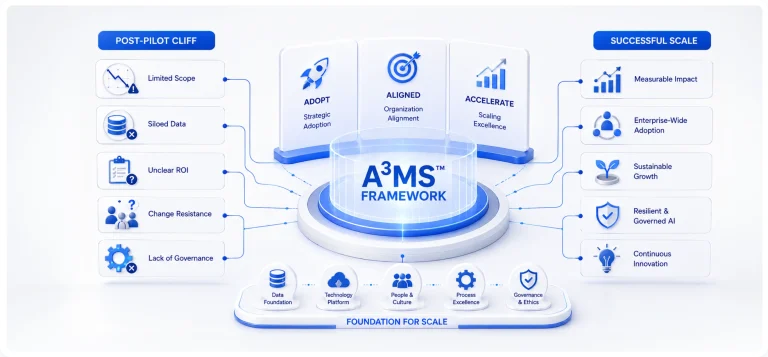
Throughout this article, we’ve covered the foundational elements leaders must prioritize to move beyond AI pilots and toward sustainable scale.
-
→
High-quality, labeled data for reliable outcomes and fair model training.
-
→
Scalable, cloud-native storage for flexible access to structured and unstructured data.
-
→
Integrated systems and data pipelines that eliminate silos and support continuous learning.
-
→
Built-in compliance controls that align with global regulatory requirements.
-
→
Real-time data flow and secure MLOps that make AI both adaptive and auditable.