
The transition from a successful AI pilot to an enterprise-wide rollout is where most initiatives stall. Pilots prove the tech works in a vacuum. However, they fail to account for the rigor required at scale.
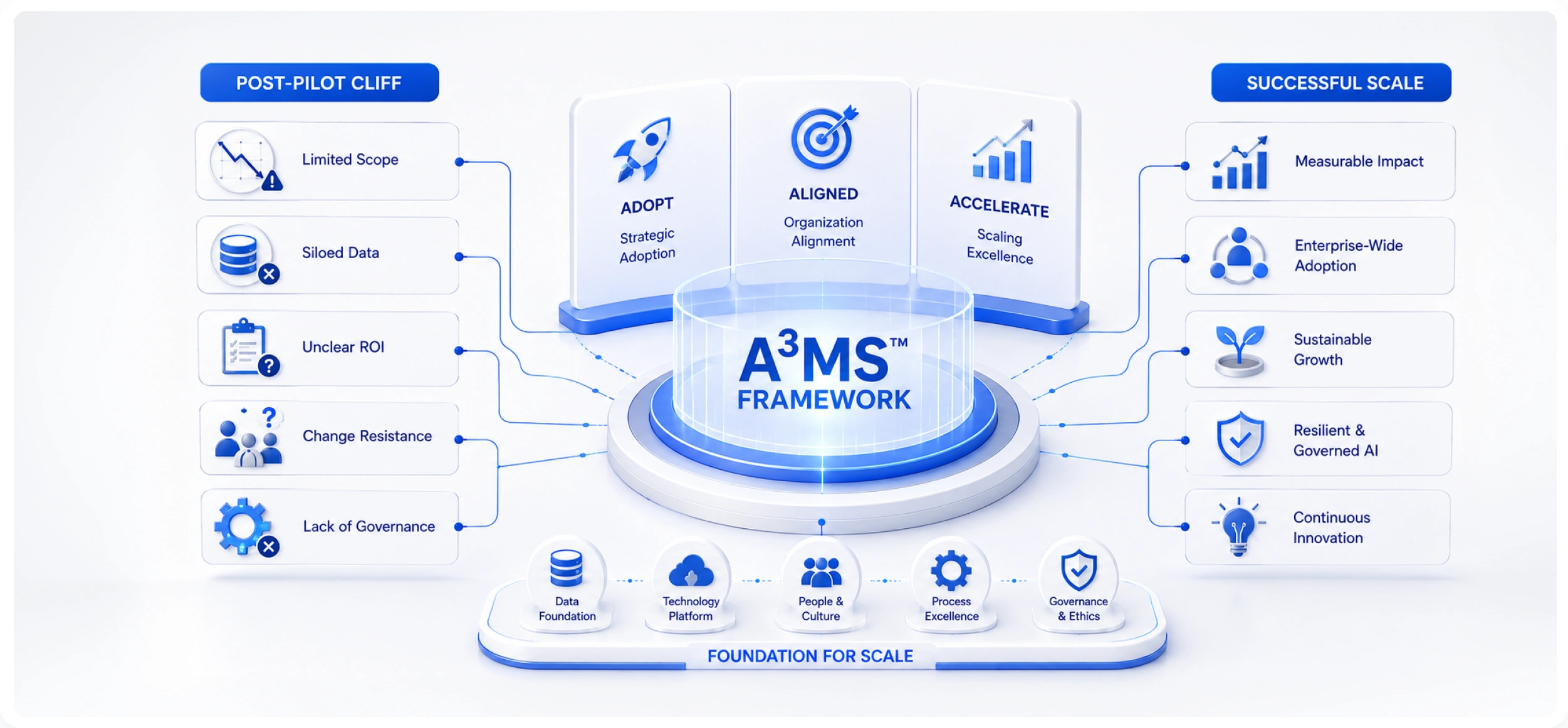
According to Accenture’s Front-runners’ Guide to Scaling AI, while the majority of enterprises are now past the experimentation phase, fewer than 15% have achieved “at scale” deployment. This “Post-Pilot Cliff” is not a failure of technology, but a failure of the operating model
Further validating this structural crisis, MIT analysis suggests that 95% of generative AI pilots fail to produce measurable enterprise impact. Critically, these failures are attributed to integration and operational shortcomings.
This data confirms that the barrier to ROI is structural; without an architecture designed for enterprise-grade variability, even the most advanced models collapse at the point of execution.
The post-pilot cliff explained
Pilots typically function within a “sandbox”, i.e., limited data sets, hand-picked edge cases, and a high degree of human buffering. When these systems are released into the broader enterprise, the lack of architectural governance leads to a rapid breakdown.
Scale exposes three primary vulnerabilities:
-
→
Process instability: Workflows that were never statistically validated begin to produce inconsistent results.
-
→
Policy ambiguity: AI lacks the inherent “common sense” to interpret gray areas in corporate policy without explicit boundaries.
-
→
Audit and security constraints: Ad-hoc integrations used in pilots fail to meet the rigorous compliance standards required for production systems.
The most critical realization for leadership is that these vulnerabilities are hierarchical. Before an enterprise can effectively address policy drift or security gaps, it must first stabilize the “broken process”.
Process instability and the absence of LSS gates
A fundamental law of automation is that automating an unstable process only accelerates the generation of defects. In the context of AI, this is particularly dangerous because LLM-based agents can hallucinate or deviate in ways that are difficult to detect in real-time.
Without Lean Six Sigma (LSS) acting as a gateway, AI amplifies variance. LSS provides the “operational truth” required for autonomy by identifying exactly where defects occur. By ensuring a process is statistically stable before it is handed over to an agent, LSS creates a foundation of reliability.
-
→
Defect propagation: In an unstable process, an AI agent may correctly follow a flawed step, leading to exponential error rates downstream.
-
→
Exception multiplication: Processes that rely on “tribal knowledge” rather than documented logic cause AI to stall or default to incorrect decisions.
-
→
The stability precondition: LSS must be a prerequisite for autonomy. If a process cannot meet a defined Sigma threshold for stability, it is not ready for AI-native execution.
Once a process is statistically stable, the next challenge is ensuring the AI reasoning stays within the lines. A stable process is useless if the agent decides to deviate from corporate policy.
Bounded autonomy: Preventing policy drift in AI agents

Most enterprise failures at scale stem from deploying “generic” agents. These systems are inherently helpful but lack domain-specific constraints and policy boundaries. When Agentic AI operates without the governing layer of Skills and MCP, trust erosion is inevitable.
Agents begin to make decisions that are technically reasonable but operationally unacceptable. Without a framework to anchor them, agents prioritize “completing the task” over “complying with the policy.” Over time, this behavior leads to subtle deviations that are difficult to detect but costly to correct.
The risks of unmanaged reasoning
When AI operates without structural limits, the organization is exposed to three primary risks:
-
→
Policy drift: Without strict guardrails, agentic reasoning can subtly move away from intended corporate outcomes over time. This leads to inconsistent decisions that undermine brand equity and operational standards.
-
→
Helpful inaccuracy: Generic agents often prioritize user satisfaction or task completion over strict policy compliance. This “helpfulness” creates significant legal and operational exposure.
-
→
Constraint management: Unbounded agents may inadvertently bypass regulatory controls to find a path to a solution, leading to systemic audit failures.
Operationalizing constraint: The new benchmark for enterprise AI
For the modern CXO, the framing must shift: Autonomy without constraints is not intelligence; it is unmanaged risk. Enterprise AI requires “Bounded autonomy,” where the decision space is explicitly defined, enforced, and monitored.
Within the A³MS Framework™, Agentic AI is never deployed in isolation. It must be governed by the other pillars to change raw reasoning into a compliant business tool.
To enforce this bounded autonomy, an enterprise cannot simply rely on the agent to “remember” the rules. The rules must be converted from static documents into executable assets.
From Intent to execution: Bridging the SOP skills gap
Traditional Standard Operating Procedures (SOPs) are documents of intent, not engines of execution. A human reads an SOP and applies judgment; a generic AI agent reads an SOP and applies a probabilistic guess. This gap is where consistency dies at scale.
The A³MS™ Framework introduces Skills as the bridge. A Skill is an executable representation of a validated procedure.
-
→
Reusable logic: Skills convert static SOPs into governed, version-controlled decision logic that any agent can call.
-
→
Enforced consistency: By using a “Skill” layer, the organization ensures that every agent, regardless of the underlying model, executes a procedure the exact same way.
-
→
Mechanism of governance: Skills allow compliance and risk teams to update a single “logic block” that immediately propagates across all autonomous operations.
Even with stable processes and executable skills, a final hurdle remains: the “black box” of system access. If an agent has direct access to your core systems, your audit trail is effectively broken.
Why direct integrations fail enterprise audits
At the pilot stage, direct API integrations or shared credentials might suffice. At scale, these become massive security liabilities and compliance blockers. Direct system access by agents lacks the granular traceability required by modern CIOs and Risk Officers.
The Model Context Protocol (MCP) serves as the control plane that solves this integration crisis. It provides:
-
→
Credential isolation: MCP ensures agents never “see” or “hold” system credentials. Instead, they request specific actions through a governed interface.
-
→
Auditability: Every action taken by an agent through the MCP is logged, timestamped, and reversible.
-
→
Separation of concerns: By decoupling the “intelligence” (the agent) from the “access” (the system), MCP allows for a reconstructable audit trail that satisfies even the most stringent regulatory requirements.
This layered approach (Stability, Autonomy, Skills, and Control) changes the role of the human-in-the-loop from an emergency responder to a strategic governor.
Human-in-the-loop by policy (not panic)
In many failed AI rollouts, Human-in-the-Loop (HITL) is treated as an emergency intervention or a “break glass in case of failure” measure. This approach increases latency and costs, effectively neutralizing the benefits of automation.
In the A³MS™ Framework, HITL is a proactive design principle, not a reactive patch.
-
→
Pre-defined escalation: Human intervention is triggered by policy, such as high-value transactions or high-ambiguity exceptions identified by LSS.
-
→
Designed oversight: Oversight is built into the workflow from day one, ensuring that humans focus on high-order work while the system handles the volume.
-
→
Risk-based reserved power: By reserving human judgment for specifically mapped high-risk decisions, the enterprise achieves safe scale without multiplying headcount.
The path to AI-native operations
The post-pilot cliff is a predictable structural failure, but it is entirely avoidable. It is the outcome of deploying AI into environments that lack stability, bounded autonomy, executable knowledge, and audit-ready controls.
AI-native operations succeed when architecture, governance, and execution mature together. A³MS™ is not an AI framework — it is the operating model required to scale AI without risk.