
With only 24% of organizations tracking hard-to-replace positions (Deloitte), the risk of losing tacit knowledge has never been higher. And it raises a necessary question: If your best people leave tomorrow, what knowledge leaves with them?
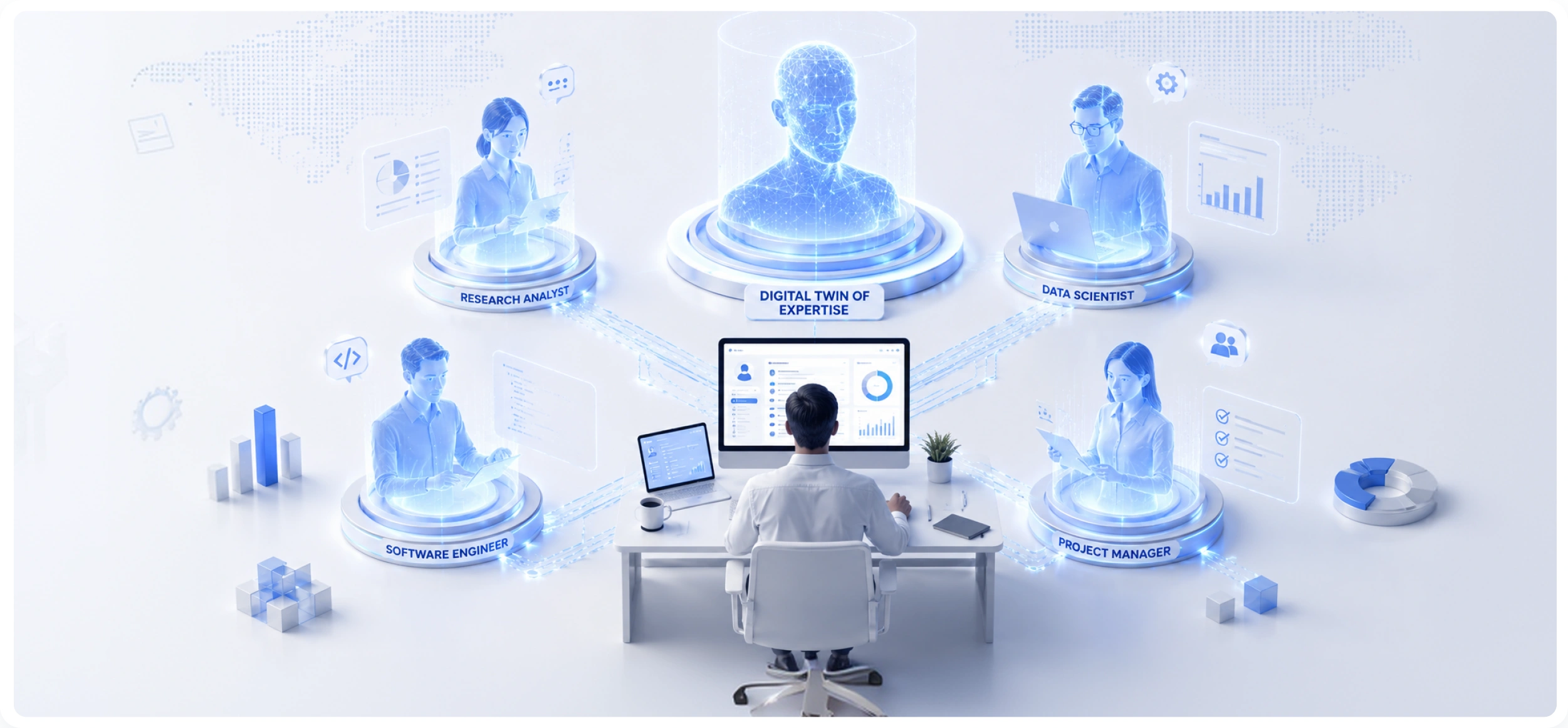
Expertise leaves with the expert. Copilots and chatbots fall short because they assist briefly and retain no memory or contextual reasoning. Synthetic colleagues approach the problem differently. They function as enduring digital twins of expert judgment, learning from historical cases, policy nuance, and human feedback. They operate as strategic assets, not productivity utilities.
This shift is not another AI adoption wave. It is a workforce-model evolution. This article looks at how these digital twins are built, how they function inside regulated industries, and what governance leaders must establish before scaling them.
What is a synthetic colleague
Synthetic colleagues operate as enduring AI entities designed to retain and evolve institutional intelligence.
Key characteristics:
-
→
Persistent identity: They remain active over time instead of resetting after each task.
-
→
Institutional training: They learn from historical decisions, workflows, and context-rich scenarios.
-
→
Mentoring cycles: Human experts refine their reasoning through structured feedback loops.
What they are not:
-
→
Chatbot: Chatbots are mostly stateless, conversation-to-conversation utilities with shallow context.
-
→
Copilot: They respond reactively to user prompts; they do not own outcomes or carry enduring accountability.
-
→
Robotic Process Automation (RPA): RPA executes predefined rules; synthetic colleagues make judgment calls under uncertainty.
The core value here is knowledge continuity. Expertise starts living in governed systems that survive reorgs, exits, and crises.
Architecture of a digital twin of expertise
A credible synthetic colleague starts with a clear architecture. No coding is required.
Core layers include:
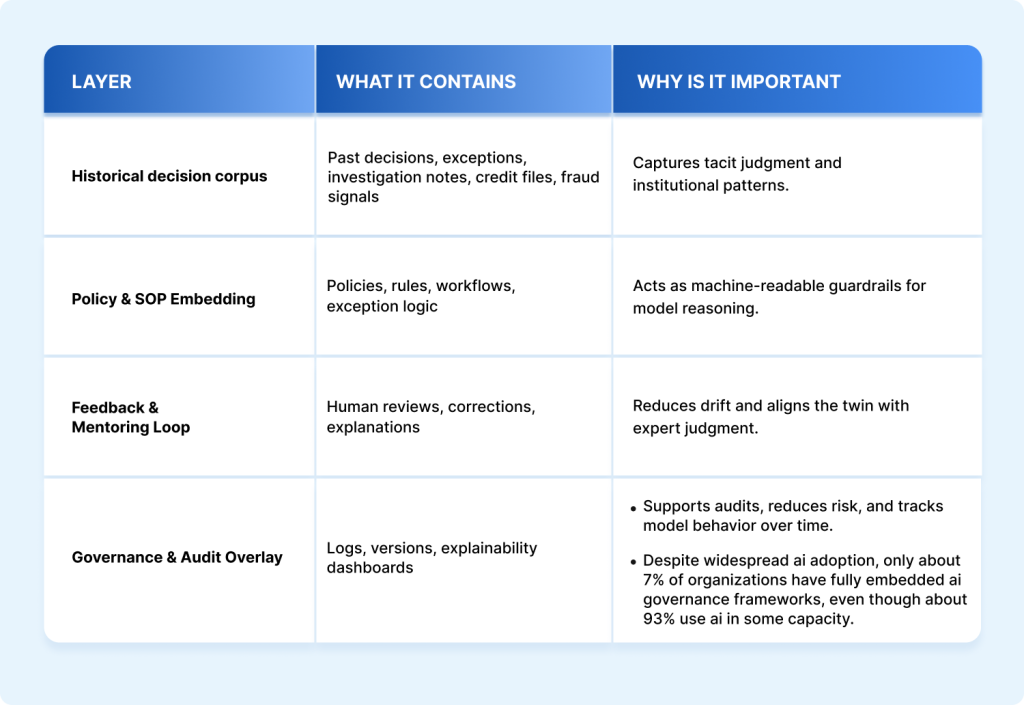
The critical design choice is to capture reasoning, not just outcomes. Why did the synthetic colleague recommend a specific client action in March when the policy changed in February? Continuous audit trails and lineage dashboards must answer that in seconds.
Enterprise use cases of synthetic colleagues
Synthetic colleagues gain the fastest traction in regulated industries. Decisions in these environments compound risk and trigger heightened scrutiny from auditors.
Use case 1: Relationship manager as a synthetic colleague
A synthetic relationship manager trained on years of client interactions, portfolio reviews, risk discussions, and internal approvals becomes a digital twin of relationship-level judgment.
Role design:
-
→
Decision-support partner: It prepares client briefs, highlights portfolio changes, surfaces risk signals, and recommends next-best actions based on historical relationship patterns and current policy—without executing decisions autonomously.
-
→
Context continuity engine: It retains institutional memory across RM transitions, tracking prior commitments, escalation history, exception rationales, and client preferences that are often lost during handoffs or team changes.
-
→
Consistency anchor: It ensures advisory guidance remains aligned with firm policy, risk appetite, and product eligibility even as markets shift, teams rotate, or coverage models evolve.
Outcome: Better-prepared relationship managers, more consistent client engagement, and reduced dependency on individual memory while final decisions, commitments, and client interactions remain firmly human-led.
Use case 2: Synthetic compliance officer
A synthetic compliance colleague acts like a 24×7 compliance memory for the institution.
Core responsibilities:
-
→
Continuous regulatory interpretation: It stores how your organization has applied rules over time. It surfaces during reviews or audits.
-
→
First responder in audits: It assembles evidence, pulls relevant decisions, and explains control logic when asked “what changed and when.”
-
→
Live query partner: It answers line-of-business questions on allowable structures, required documentation, and escalation paths in seconds.
The result: Ongoing audit readiness without burning out scarce compliance officers.
What jobs look like when expertise scales digitally
The introduction of synthetic colleagues changes roles but does not erase them. Human expertise remains central, though responsibilities shift toward directing, validating, and governing machine judgment.
Emerging role shifts:
-
→
Experts as trainers: Provide nuanced feedback that shapes decision boundaries.
-
→
Analysts as auditors: Validate reasoning, ensuring alignment with policies.
-
→
Leaders as supervisors: Track performance drift and intervene when anomalies appear.
This is a human-in-command expertise loop. People retain authority over standards, overrides, and escalation rules. The model absorbs routine judgment, reduces cognitive load, and increases capacity for high-value work.
IP, ethics & ownership of synthetic expertise
As organizations redesign work around synthetic colleagues, ownership of the intelligence they accumulate becomes the central debate. Key ownership questions include:
-
→
Individual judgment vs. firm IP (Intellectual Property): A senior underwriter trains the model. When that person leaves, does any of that training travel with them?
-
→
Team decisions vs. encoded practice: Many models reflect the unwritten norms of a department. At what point does collective behavior become part of the organization’s protected IP rather than a reflection of individual contributors?
-
→
Institutional outcomes vs. model autonomy: The model’s performance ultimately aligns with business results. Who is accountable when those encoded patterns persist long after the original contributors have moved on?
Practical guardrails:
-
→
Consent frameworks: Allow contributors to understand how their reasoning is used.
-
→
Anonymized reasoning capture: Stores role-level “how we decide,” not personal styles.
-
→
Role-based abstraction: Models represent “credit policy expertise” or “claims investigation expertise,” not a named individual’s persona.
This isn’t an abstract ethics debate; it’s a governance requirement. Enterprises must define what a synthetic colleague can retain, under what consent, and how that knowledge is abstracted into institutional IP.
Managing a synthetic colleague over time
Synthetic colleagues require structured lifecycle management to remain accurate and compliant. Without it, organizations face knowledge decay and regulatory gaps.
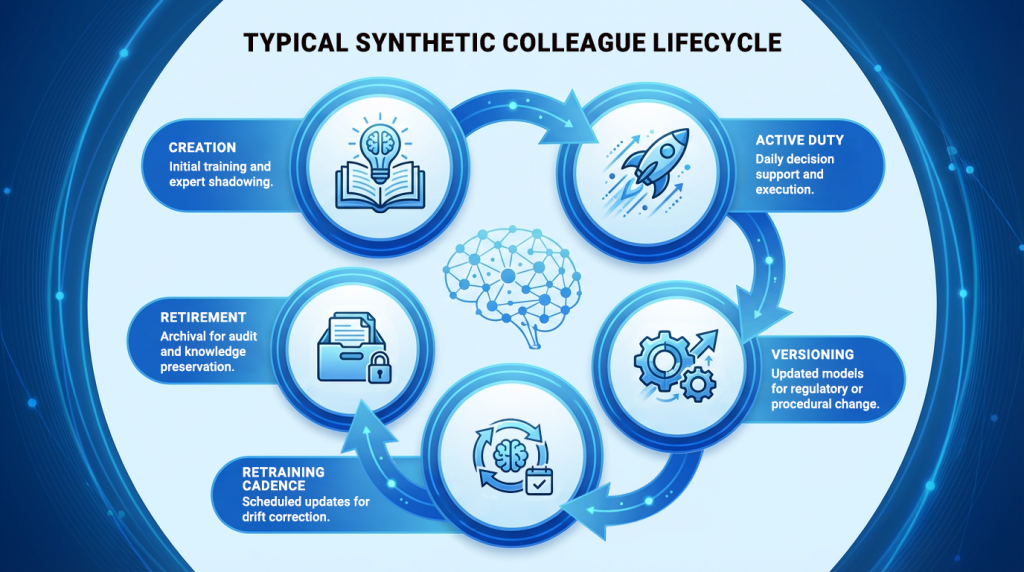
Ignoring this lifecycle creates knowledge depreciation risk: a synthetic colleague that still “thinks” in last year’s rules while the regulator reads this year’s standards. This mirrors Lean Six Sigma’s Control phase, where sustained process integrity demands ongoing verification.
Measuring knowledge continuity in real numbers
The value of synthetic colleagues becomes clearest when viewed through the economics of continuity. A practical way to express this value is through a Knowledge Continuity Index (KCI). A directional metric that captures how much institutional knowledge persists despite staffing changes. It blends model performance, consistency scores, and knowledge-transfer ratios to show how effectively expertise endures.
Illustrative directional impact:
-
→
Roughly 45% better retention: Enterprises that embed digital twins of expertise can plausibly retain ~45% more institutional knowledge through turnover and restructuring.
-
→
Reduced rework and reversals: Fewer inconsistent decisions mean fewer complaints, clawbacks, and remediation projects.
-
→
Faster onboarding: Faster ramp-up for new hires through consistent decision models.
These numbers are illustrative, not a public benchmark. The point is to give boards and risk committees a language for valuing knowledge continuity alongside capital, liquidity, and resilience.
Enterprise operating model: HR + IT as co-owners
Synthetic colleagues fail when treated as an IT side project. IT deploys models, but humans ignore unused tools without role changes or incentives.
HR’s critical contributions:
-
→
Redefine roles: Create trainers, auditors, digital supervisors.
-
→
Update performance: Measure mentoring and oversight quality.
-
→
Incentivize mentoring: Reward time spent shaping AI judgment.
New workforce KPIs:
-
→
Synthetic FTE Yield: The effective capacity contributed by synthetic colleagues compared to a baseline human FTE.
-
→
Mentor Transfer Ratio: The proportion of expert time that translates into high-confidence automated decisions over a given period.
-
→
Consistency score: Stable outputs across teams/time.
Synthetic colleagues become a new asset class, tracked like headcount, governed like systems. HR/IT partnership delivers production-scale reality.
How Flatworld.ai’s solutions fit into a synthetic colleague framework
Our products perform context-aware decision-assisting or task handling, which is central to the synthetic colleague model. Flatworld.ai’s stack matches these essential criteria:
- Persistence over transactions: Our agents maintain context across sessions, critical for digital twins of expertise.
- Enterprise-grade governance: Agentic AI inherently aligns with auditability, explainability, and workflow traceability.
- Domain specialization: BFSI, healthcare, and compliance-heavy industries benefit from customized agent behaviors.
- Scalable mentoring loops: Flatworld.ai solutions can absorb human feedback, forming the basis for continuous refinement cycles.
Building enterprises that never lose their best minds
The strategic shift is simple to state and hard to execute. Enterprises move from relying on individual brilliance to building institutional intelligence that endures. Synthetic colleagues do not replace experts. They preserve and project expert judgment through crises, growth, and turnover.
In the next decade, the most resilient enterprises will not be the ones with the brightest talent for a moment. They will be the ones that never lose that talent’s expertise, because their synthetic colleagues carry it forward.