
A Leadership Perspective on the LSS-Agentic AI-MCP Transformational Model.
For decades, the executive playbook for operational excellence was clear: Lean Six Sigma (LSS) was the gold standard for efficiency, and Robotic Process Automation (RPA) was the tool for speed. As CXOs, you invested heavily in these methodologies to squeeze waste out of the system and stabilize the bottom line. Then came the promise of Artificial Intelligence—a “magic bullet” that many hoped would finally bridge the gap between human judgment and digital execution.
Yet, despite these investments, a frustrating paradox remains. Most enterprises have mapped their processes and piloted AI, only to find that automation stalls at the edges. The results are often incremental productivity gains rather than the step-change transformation required to dominate a volatile market.
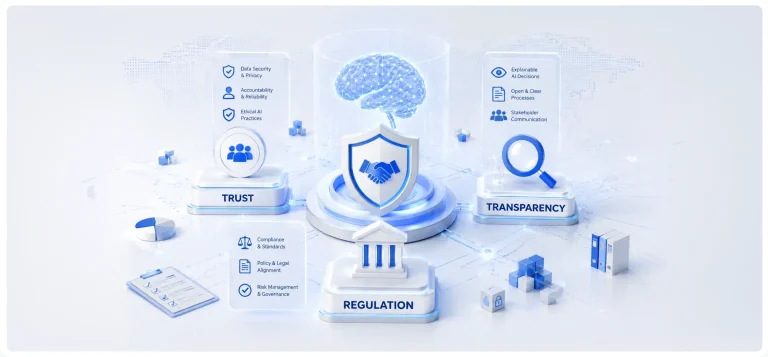
The hard truth is that technology alone does not create transformation. Operating models do. At Flatworld.ai, we have identified that the missing link is not more “tools,” but a unified architecture that governs how intelligence interacts with enterprise systems. We call this theA³MS Framework™.
The evolution of the engine: Why LSS and AI are no longer enough
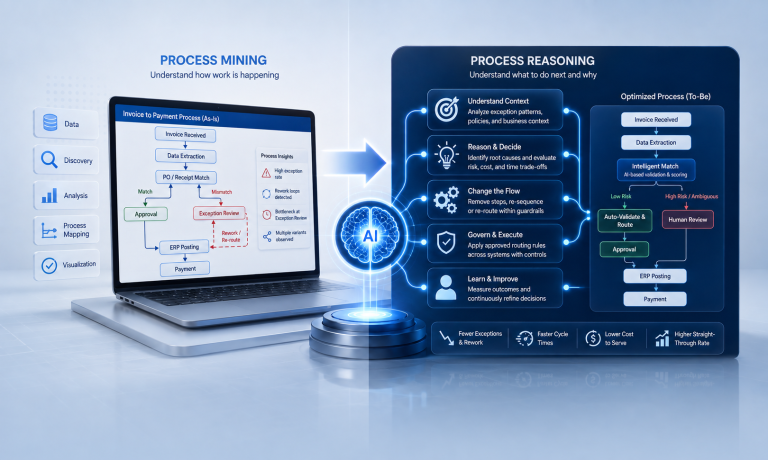
In the previous era of business transformation, Lean Six Sigma was sufficient because it provided “operational truth”. It identified where defects occurred and where judgment was required. But LSS by itself is a cost program, not an execution engine.
When AI was infused into the mix, it promised to automate decisions. However, generic AI “copilots” often lack the operational context and the strict guardrails necessary for enterprise-grade risk management. Without a way to safely connect this intelligence to your core systems, AI remains a high-potential experiment rather than a reliable driver of margin expansion.
To achieve governed autonomy, where processes are not just faster, but smarter and safer—today’s leaders must layer in two critical components: Executable Skills and the Model Context Protocol (MCP).
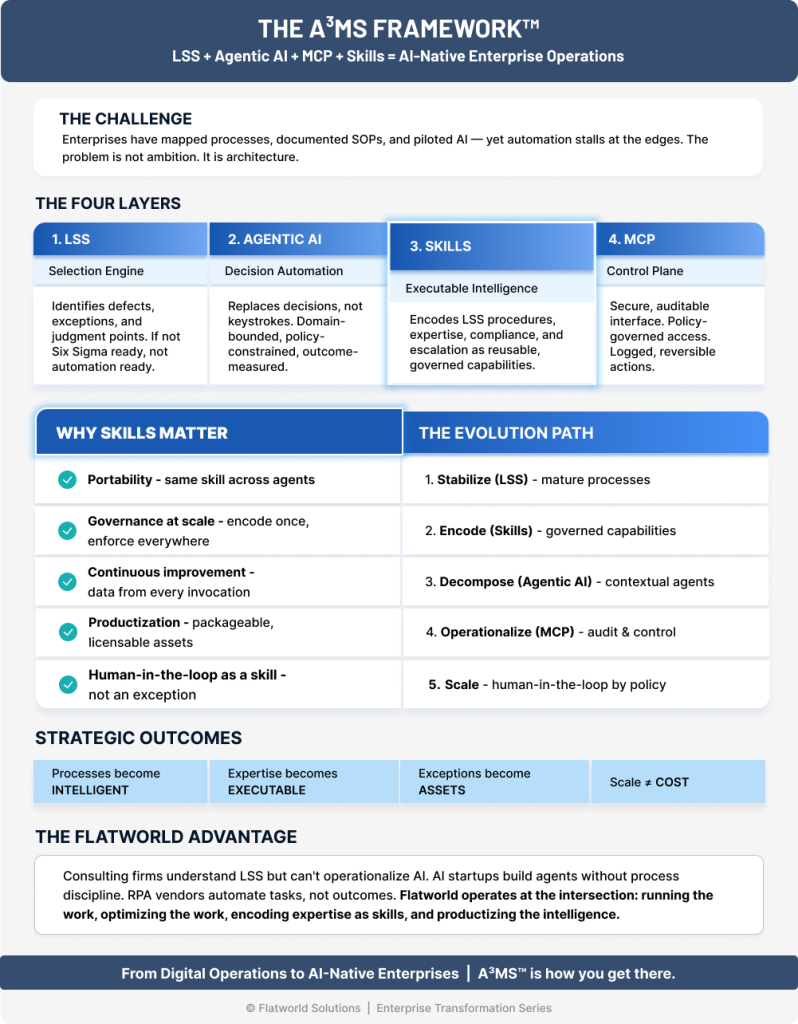
The four pillars of the A³MS Framework™
The A³MS Framework™ (LSS + Agentic AI + Skills + MCP) redefines enterprise automation as a layered system designed for the executive who demands both innovation and control. The A³MS Framework™ represents a fundamental shift from viewing automation as a toolset to treating it as a layered operating model. For the modern enterprise, these four pillars work in tandem to solve the “automation paradox” where technology often fails to bridge the gap between documented procedures and real-world execution.
1. Lean Six Sigma (LSS): The selection engine From a business process perspective, LSS provides the “statistical and operational truth” required for autonomy. Instead of automating for the sake of speed, LSS identifies exactly where defects occur, which steps generate exceptions, and where judgment—not just labor—drives the final outcome. In the A³MS™ model, LSS serves as the gatekeeper: if a process cannot meet Six Sigma thresholds for stability, it is deemed “not automation ready”.
2. Agentic AI: Decision automation: While traditional automation focuses on replacing manual keystrokes, Agentic AI is designed to replace decisions. These systems reason over context and choose actions dynamically rather than following rigid scripts. Within this framework, agents are domain-bounded and policy-constrained, operating as governed components of a workflow that can escalate ambiguity by design.
3. Skills: The executable intelligence layer Skills serve as the missing abstraction that makes AI scalable and governed. A “skill” is a reusable capability that encodes LSS-validated procedures and domain expertise into executable logic. This layer ensures that compliance and guardrails are encoded once but enforced everywhere, transforming static SOPs into living, callable intelligence that can be shared across multiple agents.
4. MCP: The control plane: The Model Context Protocol (MCP) acts as the secure, auditable interface between these intelligence layers and enterprise systems. Rather than relying on brittle, direct integrations, MCP ensures that agents request specific skills rather than system credentials. All actions are policy-governed, logged, and reversible, providing the re-constructable audit trails necessary for enterprise-scale confidence
Change management: Governance for the AI-native enterprise
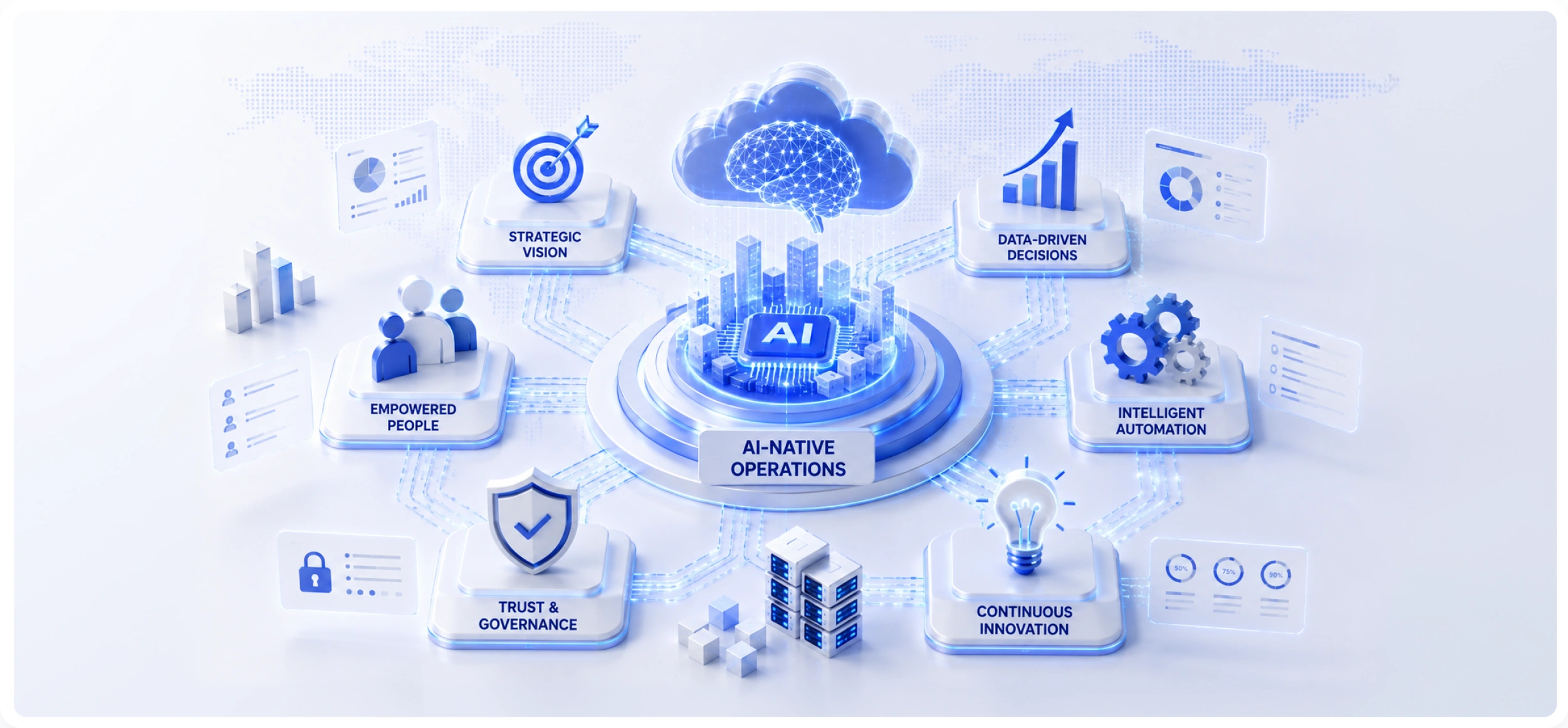
The shift from digital operations to an AI-native enterprise is not a weekend project; it is a long-term change management journey. At Flatworld.ai, we use the A³MS™ model to guide our clients through a structured evolution:
The 5-Stage change management path to autonomy
1. Stabilize (Lean Six Sigma)
The first step in any transformation is identifying and maturing processes that are truly ready for automation. At this stage, we use Lean Six Sigma to find where defects occur and which steps generate exceptions. If a process cannot meet Six Sigma thresholds for stability and statistical truth, it is not ready for autonomy. This stage ensures we are not automating “broken” workflows, which would only accelerate inefficiency.
2. Encode (Skills)
Once a process is stabilized, we transform validated procedures and domain expertise into governed capabilities known as “Skills”. This is the phase where static SOPs (Standard Operating Procedures) are converted into living, executable logic. By encoding expertise—including compliance requirements and escalation patterns—into these reusable assets, the organization creates a library of “intelligence” that can be enforced everywhere consistently.
3. Decompose (Agentic AI)
In the third stage, we deploy Contextual Agents that replace decisions rather than just keystrokes. These agents “reason over context” to choose the best action dynamically based on the specific situation. Rather than acting as standalone assistants, they are designed to be domain-bounded and policy-constrained, invoking the “Skills” encoded in the previous step to perform work within enterprise-defined guardrails.
4. Operationalize (MCP)
To move from a pilot to a full production environment, the system must be connected to enterprise infrastructure safely. TheModel Context Protocol (MCP)serves as the control plane that provides a secure, auditable interface. During this stage, we ensure that agents request skills instead of system credentials and that every action taken is logged and—crucially—reversible.
This provides the transparency and re-constructable audit trails that CXOs require for governance.
5. Scale (Human-in-the-Loop)
The final stage is achieving scale with confidence. In the A³MS™ model, scaling does not mean multiplying costs; it means implementing human-in-the-loop by policy, not as an exception caused by system failure. High-order work remains with people, while the automated system handles the volume. Because the “Skills” layer is productized and smarter over time, the enterprise can grow its output without a linear increase in overhead
This approach transforms your operations from a cost centre into a Data Flywheel. Every time a “Skill” is used, it generates data. Exceptions aren’t just errors; they become “training signals” that help the system learn and improve over time.
The strategic outcome: Scale without multiplying cost
The ultimate goal of the A³MS Framework™ is to change what it means to operate at scale. In the old model, scaling meant hiring more people and increasing costs linearly. In the AI-native model, your expertise becomes a packageable, licensable asset.
For the modern CXO, the result is not simply “fewer people.” It is higher-order work for your staff, faster cycles for your customers, and measurable margin expansion for your shareholders.
The future belongs to the organizations that can encode their expertise and govern their agents. At Flatworld.ai, we are ready to show you how the A³MS Framework™ can become your organization’s new engine for market leadership.
Contact us if you would like to schedule a deep-dive session to assess which of your current business processes are “Six Sigma ready” for Agentic AI and MCP? It could be a game changing moment