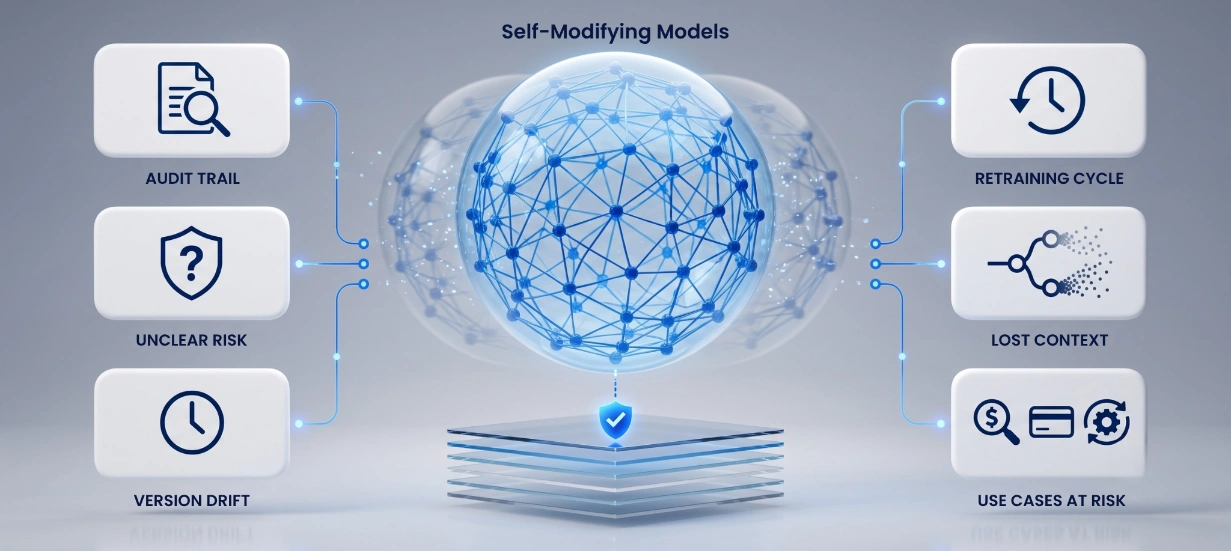

AI models are evolving faster than our ability to understand them. Self-learning models that power fraud detection, credit scoring, and process automation are now retraining themselves autonomously, sometimes daily, updating their parameters without waiting for human approval. While this adaptability provides great business value, it creates a fundamental problem: your last audit is obsolete before the ink dries.
Traditional validation cycles were designed for static systems. You would validate a model, sign off on it, and move on. With traditional audit methods ‘lagging’ behind, the revolutionary control of adaptive AI has become its own Frankenstein. Uncontrolled modifications are the doorway to risks, operational errors, biased decision-making, and damage to your reputation.
For business leaders, this is an existential governance challenge. When models continuously evolve, how do you prove compliance? How do you explain a decision made by a model version that no longer exists? And when your models retrain themselves every night, your last audit is already obsolete.
It’s time to meet this problem head-on and make the best of what adaptive AI has to offer for organizations.
The state drift challenge
Let’s talk about what happens when models evolve without proper oversight. The industry calls it “state drift” as they are continuously shifting and updating themselves even while you are sleeping. Continuous retraining due to changes in parameters, thresholds, and decision boundaries alters how your model behaves over time.
Think of it like this: you deploy a model on Monday. It makes decisions based on specific logic. By Friday, after several retraining cycles, it’s basically a different model making different decisions under the same name. The outputs become inconsistent, traceability goes out the window, and your validation documentation describes a system that no longer exists.
The risks compound quickly:
-
→
Models evolve, validations don’t: A traditional periodical report can be rendered useless in a matter of hours if the AI model has autonomously updated. The inability to rely on historic validation creates a dangerous gap in compliance and auditing, directly impacting the company’s risk environment.
-
→
Accountability lost: If the auditing system throws up errors, such as fraud alerts, it will be difficult to track the source of the deviation, since it is quite impossible to pinpoint the version of the model responsible. Without version control, you’re guessing.
-
→
Regulatory risks, tricky AI governance: AI governance laws are evolving globally, and regulators are specifically concerned about auditing and compliance risks. The EU AI Act imposes heavy fines for non-compliance, giving precedence to traceable, transparent, and robust systems.
-
→
Inconsistent KPIs: Uncontrolled state drifts open the window for missed KPIs. The risks of false positives and inaccurate forecasts increase and impact the company’s operational workflow.
The costs of non-compliance are at an all-time high. Under the EU AI Act regulations, penalties can reach up to 7% of total annual turnover or €35 million. This makes deploying autonomous, self-modifying models a high-stakes decision.
Compliance integration across regions
The rising cost of non-compliance is a sign that global regulators are now seeking markers of operational resilience that can be ensured only by temporal audit trails.
-
→
EU AI Act & DORA: The EU has started classifying AI as ‘high-risk’ in sectors such as credit scoring. It has also mandated increased fines on unverified and untraceable accounts.
-
→
MAS (Singapore) FEAT Principles: The Monetary Authority of Singapore’s FEAT principles (Fairness, Ethics, Accountability, and Transparency) explicitly address the challenges of evolving AI systems. The framework requires financial institutions to maintain explainability even as models adapt.
-
→
RBI (India) Regulatory Sandbox: The RBI sandbox offers a controlled test environment for adaptive AI, but banks need to demonstrate continuous monitoring and auditability throughout the pilot. This is essential to capture details of logging and traceability to promote audit-readiness and compliance.
Temporal audit trails: The new backbone of AI governance
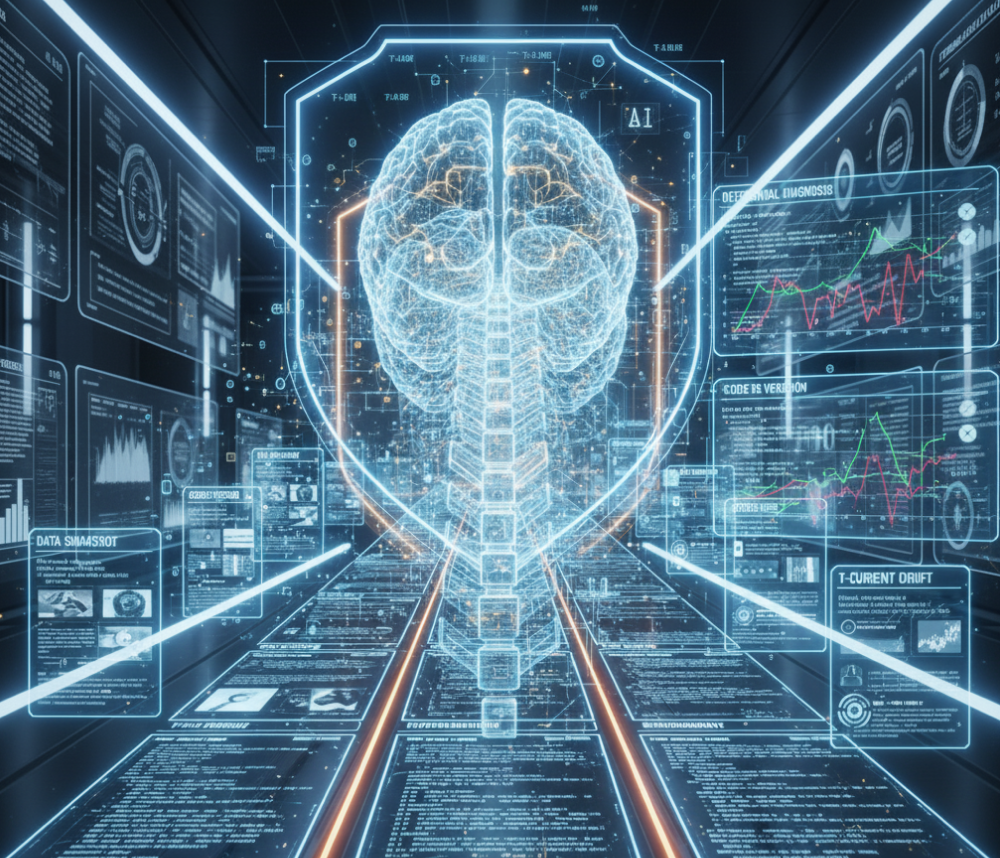
The only real solution for state drift is temporal audit trails. These are a preserved history of the model’s entire lifecycle. Every decision and every response is accounted for. Not only does this create an unbroken chain of causal data, but it also forms the backbone of Continuous Audit. Temporal audit trails are the foolproof way to combat the cons of self-modifying AI models.
Model versioning like Git commits
Every change that the autonomous model goes through is a commitment in motion. Every decision, code change, and retraining trigger must be accounted for. These commits must create logs of the metadata and a timestamp that describes the change in real time. Together, this forms an unbroken, non-repudiable source of accurate historical data that helps regain control of AI governance.
Blockchain / Merkle Trees for immutability
Trust can only be established from immutable proof. To establish a strong, tamper-proof lineage of your model’s historic updates, it is essential to chain every model to a decentralized ledger or Merkel Tree. The chain is a veritable record of the model’s lifecycle, with each link accounting for traceable, verifiable events, updates, and changes. This chain of data is more than a record — it is the gatekeeper of truth in an increasingly dynamic environment and an invaluable resource for external auditors.
Replay infrastructure
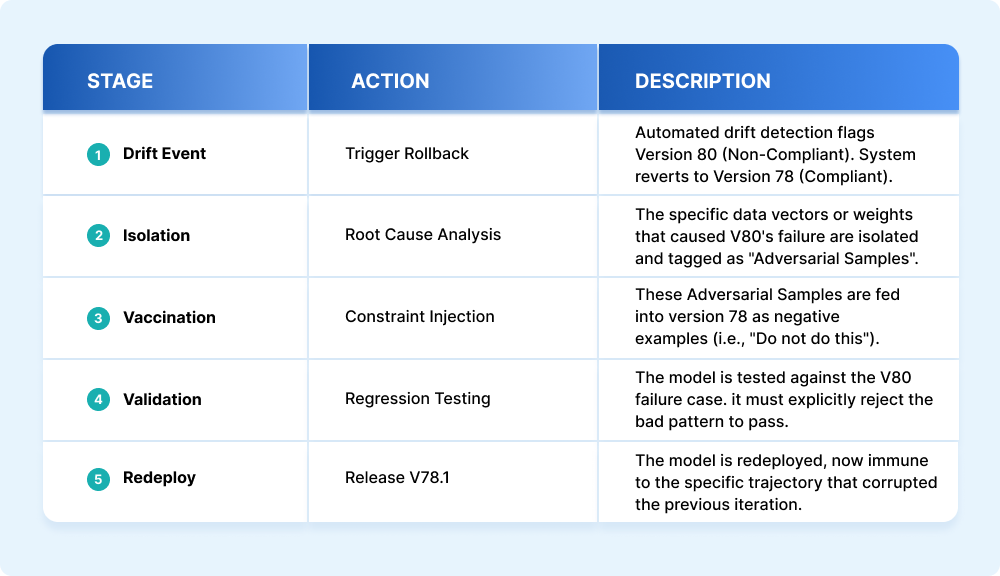
A common pitfall in adaptive AI is the “relapse cycle,” where a model is rolled back to a safe version (e.g., Version 78) only to re-learn the same erroneous patterns that corrupted the discarded version (Version 80) once exposed to the same live data. To break this cycle, organizations must move beyond simple resets and implement Adversarial Constraint Injection.
In this workflow, the data subsets or decision branches responsible for the drift in Version 80 are not merely discarded; they are isolated and converted into “negative constraints” or “failure test cases”. Before the restored version 78 is allowed to update again, it is retrained with these specific constraints to effectively “vaccinate” it against the previous error trajectory. Industry data suggests that employing such Continuous Learning (CL) feedback loops can reduce recurrent model failures by detecting drift patterns early. Without this “memory of failure,” enterprises risk wasting compute resources on repetitive retraining loops, a phenomenon known in MLOps as catastrophic forgetting or regression.
Process map: The anti-relapse loop
A temporal audit trail is the foundation of any replay infrastructure. It captures each model version exactly as it existed — including its inputs, parameters, data slices, and decision paths — so teams can reconstruct drift events with full fidelity. Without this replayable lineage, enterprises cannot reliably perform root-cause analysis, test constraint injection methods, or guarantee that a rolled-back model will not relapse into the same failure mode.
The process map below highlights how erroneous or “bad” data is isolated, examined, and fed back to reinforce and refine the “good” model:
The compliance tax and operational hardships
The shift to continuous auditing forces organizations to confront significant financial and technical hurdles often described as the “compliance tax.” Implementing granular temporal audit trails creates a massive data footprint, with industry analysis suggesting that ongoing maintenance and observability can consume 15% to 30% of initial AI development costs annually.
The regulatory burden is equally steep; estimates indicate that for European SMEs deploying high-risk AI, compliance costs under the EU AI Act could reach up to €400,000 per system, potentially reducing AI investment by nearly 20% due to the overhead. Beyond direct financial outlays, the technical debt of maintaining replay infrastructures requires specialized talent—a scarcity that significantly hinders adoption, as auditors must now possess deep machine learning literacy to interpret the very logs they are meant to govern.
The investment may be high, but the alternative is far costlier. Continuous auditability builds traceable, defensible AI systems that regulators trust and customers rely on—turning compliance from a burden into a long-term operational advantage.
Practical BFSI scenario
Let’s ground this in reality with a real-world scenario that keeps risk officers up at night.
Challenge:
A North American digital bank was struggling with ATO and AO fraud. Their traditional static fraud tools were being rendered obsolete regularly and couldn’t handle the complexity of errors. After deploying adaptive AI, the state drift resulted in 0.1% false positives due to model retraining. The situation had the potential to escalate quickly and dismantle the existing structure of valid transactions.
Solution:
By implementing temporal audit trails, the bank established a replay infrastructure, enabling the company to gain full visibility into the lineage of variances in updates and parameters. With complete transparency, the bank can now easily analyze the root cause and roll back to the last compliant version.
Result:
The bank regained control over its verifiable records and saw a 177% improvement in fraud detection. Service continuity was restored in minutes, and the organization achieved comprehensive cybersecurity protection.
This maps directly to Lean Six Sigma’s “Measure–Analyze–Improve–Control” cycle. You measure model performance continuously, analyze deviations from baseline, improve through targeted rollbacks or fixes, and control through sustained monitoring. Without temporal audit trails, you’re stuck at “measure” with no path forward.
Tools, frameworks & emerging solutions
The industry is evolving fast, especially to create space for continuous audit to replace periodic ones. The latest advances are focused on building governance by feeding CAS directly into the Machine Learning Operations (MLOps) pipeline.
-
→
Model cards (Google AI): A standardized model for dynamic and shifting reports that captures the model’s key variance metrics and can be used to revise existing static documentation for a foolproof auditing experience.
-
→
AI Observability tools: Platforms like Truera, Arize, and WhyLabs specialize in continuous monitoring of drift variances, including explainability monitoring and performance tracking. They are the critical overseers of the continuous editing workflow.
-
→
MLFlow / Weights & biases: The MLOps tools track the lineage of every model, every experiment’s code, parameters, and data. This ensures a chain of unbroken truth that prepares the ground for continuous audits.
-
→
Data provenance systems: This is essential for end-to-end tracking of training data, from its source to transformations, leading up to compliant versions along the way.
-
→
Blockchain repositories: Storing model hashes in decentralized blockchain repositories is a perfect way to resist discrepancies in lineage tracking and offers a tamper-proof record of every model version throughout its lifecycle.
Metrics for AI auditability
Self-modifying models are increasing the complexity in tracking and securing historical lineage. The power of such revolutionary models can only be fully exploited if their audit-readiness can be measured and controlled in real time. This shifts the focus from providing periodic reassurances or validation to compliance and governance.
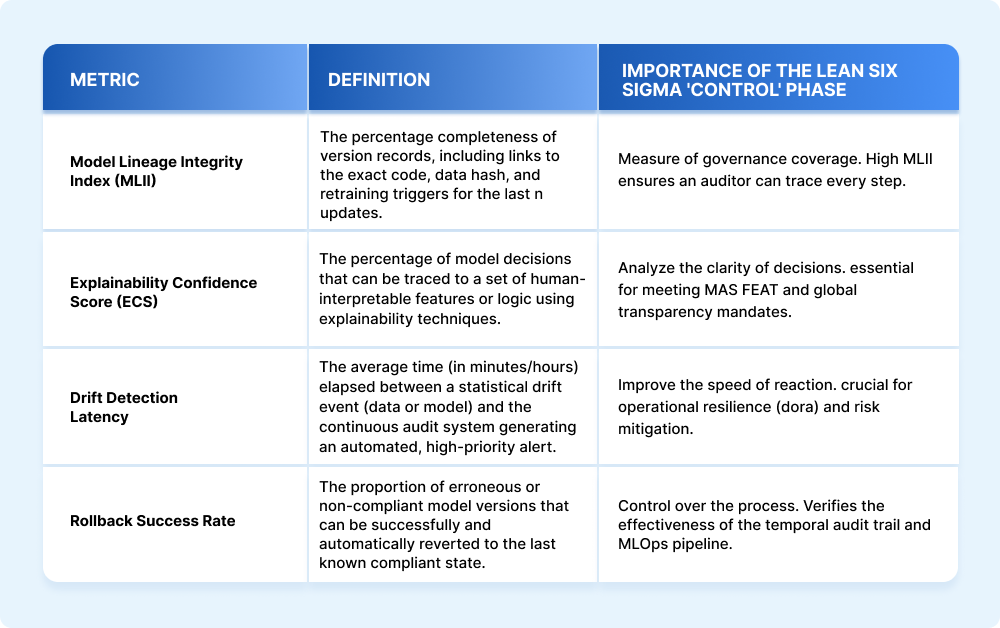
Evaluating these metrics helps adaptive AI systems remain compliant with the ‘Control’ phase of Lean Six Sigma. This ensures consistency in compliance and operations, even as the model evolves over time.
These metrics keep the model grounded in the ‘Control’ phase of Lean Six Sigma — ensuring consistent performance and compliance, even as the model keeps evolving.
Auditability as the license for adaptive AI
1 in 3 audit partners report that their primary industry is leaning towards AI in their financial reporting processes. In a world getting consumed by AI models at a blink-fast rate, adaptive AI, without oversight and control, can build up to be a major liability at the enterprise level. The autonomous self-modifying character of these AI models is in direct conflict with traditional annual audit cycles — creating a gap and a window for inconsistencies and cybersecurity threats that can seriously damage the organization’s daily operations.
The solution lies in temporal audit trails, i.e., embedding a Continuous Audit System (CAS) into the AI deployment and development lifecycle. This ensures comprehensive and detailed tracking of the model’s behavior over time and helps create an unbroken lineage of tamper-proof data with the option of instantly rolling back to the last compliant version.
The result is complete visibility into the entire process, identification and pre-emption of errors, and establishing a verifiable lineage for external auditors. With CAS in place, the audit-readiness of the organization is up to mark, fostering a culture where innovation never outpaces accountability.