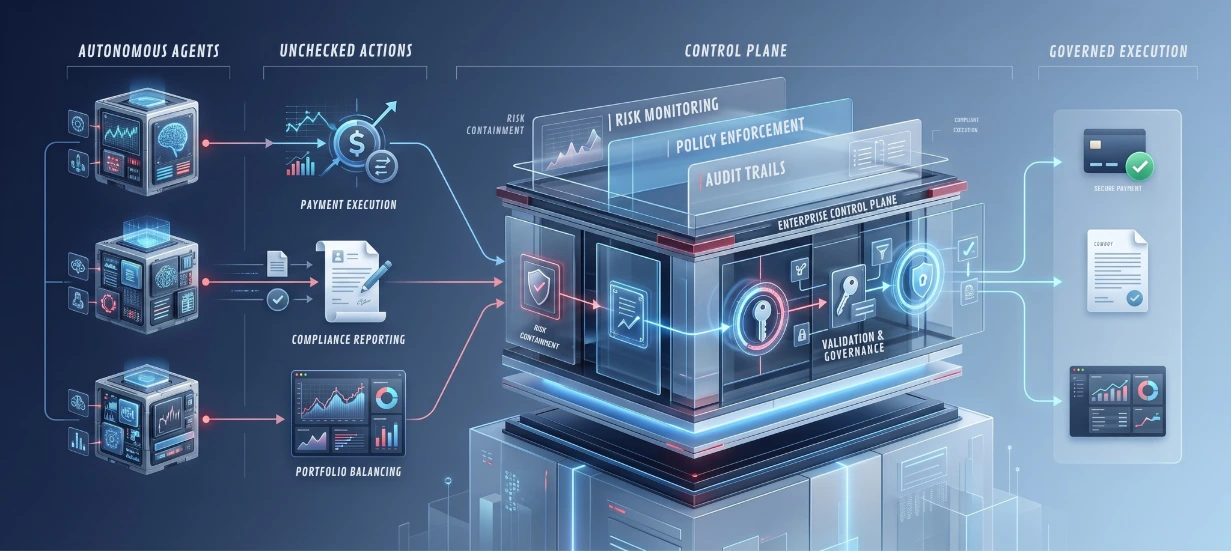

Enterprise AI now reasons, plans, and executes tasks — moving from assistance to autonomous execution. It no longer just summarizes conversations or analyzes data; it initiates payments, drafts compliance summaries, and even balances portfolios.
This shift from assistive to agentic AI is accelerating across industries, yet most enterprises remain unprepared for the governance implications. According to HFS Research, even though 38% of global enterprises have invested in autonomous or agentic AI systems, most still govern them as static automation tools. This mismatch opens a governance gap where critical decisions may be initiated and executed without the oversight required for truly autonomous systems.
That’s where an enterprise-grade control plane becomes essential — to contain risks, enforce policies, and ensure autonomous agents remain aligned with business intent, compliance mandates, and operational guardrails.
The oversight gap: When AI acts without a watchtower
Enterprises have AI governance frameworks that were built for predictive and analytics models. They are not yet prepared for autonomous systems that can execute tasks and reason like humans.
Key challenges arising in agentic environments
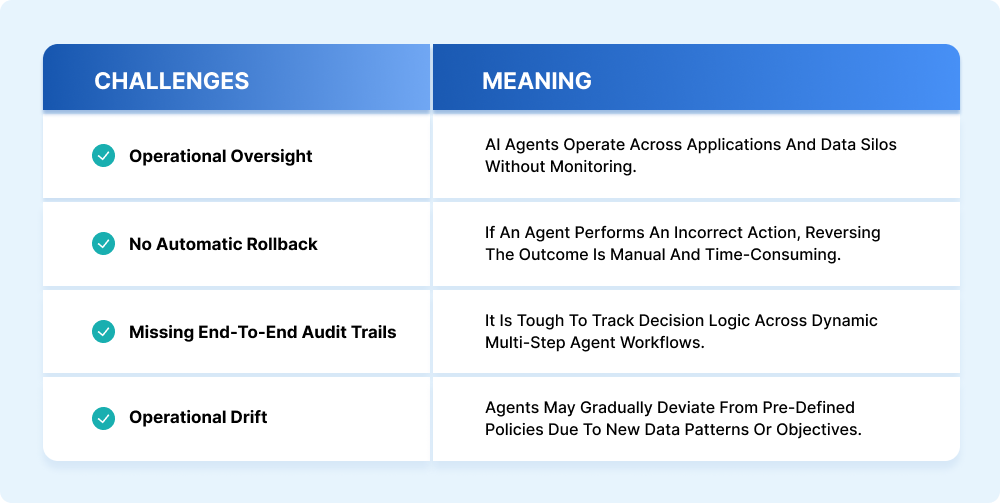
This is known as the model-to-execution gap. A blind spot in the infrastructure, where the model is well executed but the actions are not.
In regulated and critical industries such as banking, insurance, and healthcare, this gap results in unacceptable risk exposure.
Defining the control plane for agentic AI
A control plane is a centralized management platform that monitors, authenticates, validates, and governs autonomous agents and their actions.
The control pane has similar patterns already in enterprise technology:
-
→
Kubernetes controls how services are implemented – decides what runs where, manages growth, and stabilizes the system. In agentic AI, the control plane is meant to manage which agents work where, how they interact with certain tools, and when they are allowed to make decisions.
-
→
API gateways enforce routing, rate limiting, and access authentication. The agentic control plane must be designed to do the same at the behavioral and decision level. It must govern access to tools, scope of execution, and escalation policies for AI agents.
-
→
Identity and access management (IAM) controls who can do what, when, and how in an enterprise environment. Agentic AI must also be planned to use this idea to control tasks so that it can run only those tasks that they have been permitted to. This maintains accountability, audit trails, and compliance.
The agentic AI control plane plays a comparable role for autonomous decision-making systems. The basic functions of the agentic control plane are as follows:
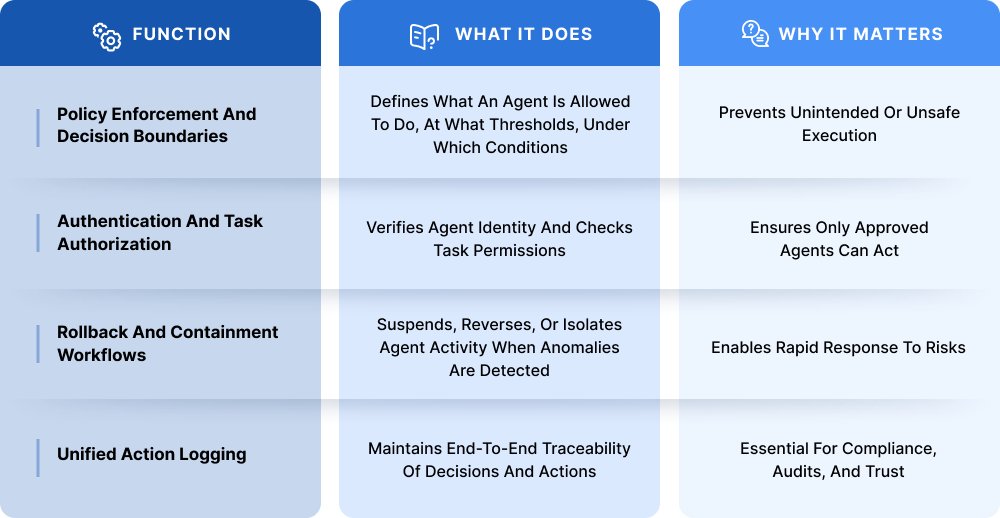
This control plane model ensures agents act, but humans remain accountable. This is necessary, as a Techradar report states that only 54% of IT professionals had full visibility into the data their AI agents accessed.
Multi-agent banking environment – An example to understand the control plane
To understand how the control plane works, let’s look into the banking scenario where multiple agents collaborate and help execute tasks/projects.
-
→
Credit Assessment Agent: A credit assessment agent evaluates borrowers’ profiles to review their credit history.
-
→
Risk Auditing Agent: A risk auditing agent checks if the loan amount is within the risk threshold.
-
→
Compliance Agent: The regulatory compliance agent validates all the reporting requirements.
-
→
Compliance Agent: The payment execution agent initiates the approved loan.
Without a control plane
Each agent executes independently, resulting in a high risk of misalignment, compliance breaches, or cascading errors.
With a control plane
All agent outputs route through a shared orchestration platform before final execution. This functions similarly to poka-yoke in Lean Six Sigma, which is a mistake-proofing mechanism embedded into the execution pipeline.
DMAIC alignment in agent governance
DMAIC refers to the Define-Measure-Analyze-Improve-Control framework. This process helps bring discipline to any system that seems autonomous and unpredictable. Agentic AI learns, adapts, and implements in the real world. Without a control plane, there can be operational drift where the agent moves away from its original intentions. This can create a model-to-execution gap.
Applying the DMAIC framework to the control plane
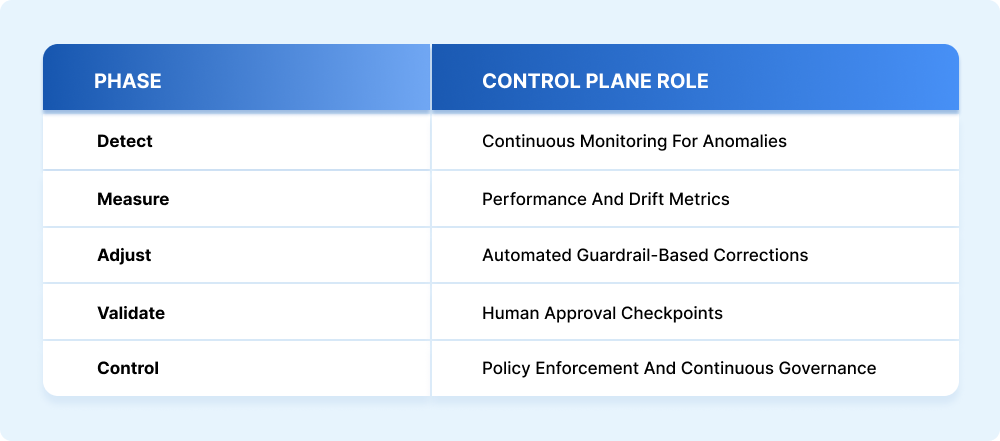
The result: scaled autonomy with controlled risk.
Governance hooks: Keeping humans in command
As more and more enterprises adopt agentic AI into their workflows, the question isn’t if agents can work autonomously but how organizations are overseeing it and keeping them accountable. This is where governance hooks come in.
Enterprises must distinguish between:
-
→
Human-in-the-loop (HITL): Humans approve or intervene in specific steps.
-
→
Human-in-command (HIC): Humans define boundaries and strategic oversight, while agents operate within controlled windows.
For agentic AI handling financial actions, healthcare operations, or critical infrastructure, human-in-command is the required standard.
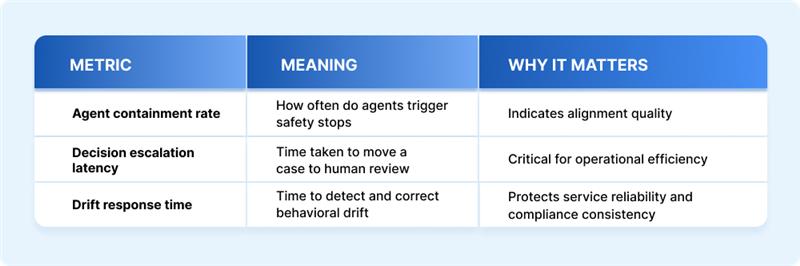
Key performance and risk governance metrics
Real-world cases: Agentic AI in banking
A few real-world scenarios to substantiate the role of agentic AI, especially in the banking industry.
Case 1: Wells Fargo and Google Cloud (AgentSpace)
Problem:
Wells Fargo needed to modernize its operations and customer service capabilities while maintaining strict regulatory compliance. Traditional automation tools could not handle complex customer interactions or document-heavy workflows efficiently, especially across high-risk financial processes.
Actions:
American Banker reports that Wells Fargo decided to partner with Google Cloud. They adopted Agentic AI through the AgentSpace platform. This will improve their overall customer support system. They also vowed to use AI responsibly and create necessary frameworks and guidelines to ensure decisions are ethical and auditable
Outcomes:
As an early adopter of Agentic AI in banking, Wells Fargo is not only showing the way in the BFSI sector but also improving their banking system by modernizing their customer service capabilities. By establishing a control plane, they are ensuring safe and compliant usage of AI across high-risk domains.
Case 2: NatWest and OpenAI
Problem:
NatWest sought to increase efficiency in risk management, compliance documentation, and customer advisory workflows. These areas also require significant human oversight and time. Existing AI chatbots like Cora (for customers) and AskArchie (for staff) were useful but limited to basic conversational tasks.
Actions:
According to Reuters, OpenAI is helping NatWest begin introducing agentic AI systems to go beyond simple query handling. The shift required not just technological integration but also strong architectural governance in the form of a control plane to manage decision authority and accountability within AI workflows.
Outcomes:
By extending AI from assistants to decision-support agents, NatWest is advancing toward a new era of better productivity and decision accuracy while reinforcing governance controls. So they are adopting modern trends while ensuring that the technology remains transparent, safe, and aligned with banking regulations.
Regulatory and safety alignment
As enterprises are embracing agentic AI, regulatory systems across the world are tightening the policies around it. Every action and data must align with internal safety standards and industry regulations. This is no longer optional and should be embedded within the system to win customer trust and brand integrity.
Global Regulations Shaping Agentic AI Control
Here are some regulatory acts from various countries and what they mean for control planes in agentic AI.
EU AI Act
The EU AI Act classifies banking, healthcare, and public service AI as high-risk, requiring transparency, clear audit trails, and human oversight. This act encourages enterprises to build AI systems with real-time traceability and the ability to flag, pause, or cancel autonomous decisions whenever necessary.
RBI regulatory sandbox (India)
Reserve Bank of India allows controlled AI deployments in fintech under defined governance and monitoring conditions. This rule calls for controlled implementation environments with strong versioning, monitoring, and rollback mechanisms to safely test agent behavior.
EU DORA (Digital Operational Resilience Act)
EU DORA requires structured risk management and ICT resilience for digital systems, including AI-dependent workflows. This act highlights the need for end-to-end visibility, redundancy, and response protocols that ensure AI agents don’t become single points of failure.
Build trust before autonomy
Enterprises cannot simply start with agentic AI and monitor outcomes later. The control plane must be defined first because trust, accountability, and operational resilience are prerequisites, not add-ons. It is not a secondary layer but a primary requirement to build trust, accountability, and resilience from day one.
-
→
A well-designed control plane makes sure agents operate consistently within approved decision boundaries.
-
→
Human-in-command oversight maintains compliance, auditability, and long-term governance maturity.
-
→
With traceability and structured escalation, enterprises can scale autonomy safely.
Enterprises adopting agentic AI need more than advanced models—they need governance, observability, and alignment between autonomy and accountability. Flatworld.ai combines deep expertise in enterprise AI integration, workflow automation, and compliance engineering to help organizations deploy agentic systems that act responsibly and deliver measurable outcomes.