
Retail space planning is moving from static, annual resets to a living, data-driven system. AI-infused planogram as a service—combining forecasting, optimization, visual merchandising, store tasking, and computer vision—can localize layouts by store, re-optimize weekly, and verify execution from shelf photos or RFID. For Global Capability Centers (GCCs) and outsourcing partners, this is both a threat and a once-in-a-decade opportunity: the work shifts from manual planogram production to outcome-based, closed-loop merchandising. Those who adapt quickly will own the new category; laggards will be confined to low-margin, shrinking tasks.
The why: speed, localization, and closed-loop execution
Three forces are driving urgency. First, retailers need speed. Promotions and seasons change faster than traditional planning cycles, especially in fashion and home, where assortments and size curves turn quickly. Second, localization pays. AI can tailor facings, styles, and size distributions by store cluster and fixture capacity, boosting sales per square foot and availability. Third, execution must be verified. Computer vision and mobile audits compare shelf photos to planograms, score compliance, and trigger fixes—creating a learning loop that continuously improves the next plan.
What “AI Planogram as a Service” really delivers
Modern services ingest POS and inventory (often RFID in apparel), product images and dimensions, fixture specs, and store metadata. Models forecast demand and size curves, estimate space elasticity, and run mixed-integer optimization to assign items and facings to each bay, wall, or table under real constraints and visual rules (brand blocking, color flow, outfit adjacencies). A publishing layer pushes plans and lookbooks to stores with task lists. Photos or scans verify compliance; computer vision highlights gaps and out-of-stocks; the system re-optimizes on a weekly or biweekly cadence. The outcome: higher sales and GMROI, better size availability, and fewer hours wasted on rework.
Implications for GCCs and outsourcers
The center of gravity moves from headcount to capabilities. Winning providers will pair category and visual-merch expertise with data science, optimization, and computer vision, then wrap it in SLAs tied to outcomes (compliance %, publish windows, uplift). This means shifting from “we deliver planograms” to “we deliver sales per square foot, availability, and speed.” It also means building an operating model that can turn plans overnight across hundreds of stores, with human-in-the-loop quality control for edge cases.
The new capability stack
To compete, GCCs and partners need four pillars. Data and integration: reliable product masters and images, fixture libraries, store layouts, and 12–18 months of POS and inventory, plus connectors to retailer tasking apps and content hubs.
-
→
AI/Optimization: Forecasting, size-curve estimation, elasticity modeling, and solvers (e.g., OR-Tools or Gurobi) to optimize facings within fixture constraints and presentation minimums.
-
→
Visual and publishing: A plan editor that outputs clear 2D bay shots and lookbooks, and a store-tasking layer to ensure work gets done.
-
→
Execution intelligence: Mobile photo audits and computer vision to score plan vs shelf, escalating non-compliance, and learning from it. Keep the optimization and analytics as proprietary IP; partner for store apps and vision where it accelerates time-to-value.
Operating model and talent
Form cross-functional pods aligned to categories (e.g., denim wall, tees table, bedding). Each pod blends a space planner and visual merchandiser with a data engineer, ML/optimization specialist, and store enablement lead. Add a QA and annotation team to train and validate computer vision models. Standardize “overnight turn” playbooks: intake data by noon, run optimizations, human review for edge fixtures, publish by store manager shift start, and auto-generate tasks and visuals. Measure relentlessly: sales/GMROI uplift, $/sqft, plan compliance %, size availability index, and labor hours per reset.
How to evolve quickly
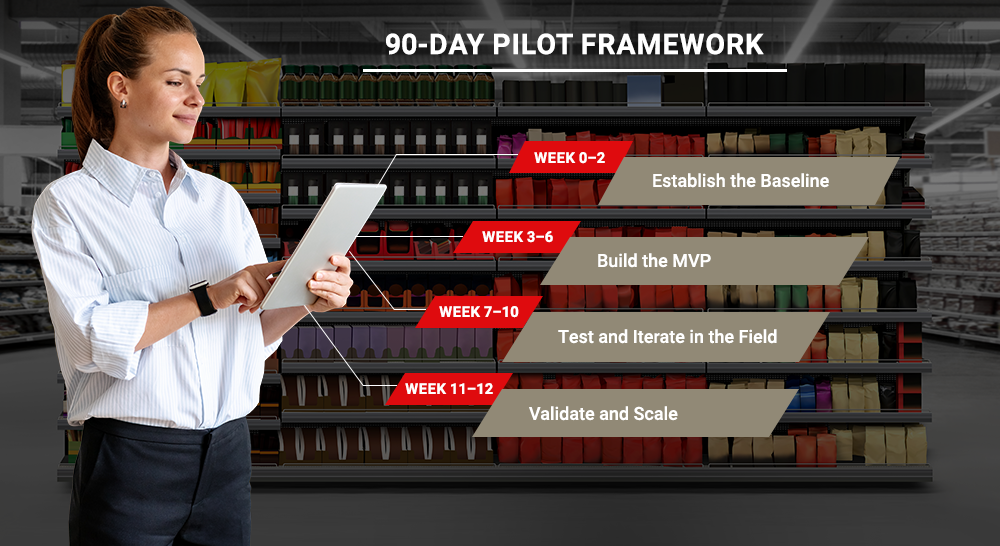
Start with a 90-day pilot in two to three categories and 50–100 stores.
-
→
Week 0–2: Audit data, fixtures, and KPIs; lock success thresholds.
-
→
Week 3–6: Stand up the MVP—forecasts, size curves, optimization for one wall and one table type, visual outputs, and a lightweight store app or partner integration.
-
→
Week 7–10: Run the field pilot with A/B stores; collect photos and scans; iterate rules.
-
→
Week 11–12: Report uplift, refine the solver, and agree on the rollout roadmap. Price as set up plus per-store-per-month, with add-ons for categories and compliance modules. Bake in SLAs for publish windows and compliance targets.
Risks and practical mitigations
Data quality is the biggest drag—fix it upfront with a cleanse and enrichment pass; fill missing dimensions via vendor catalogs or vision. Computer vision for apparel can be noisy; start human-in-the-loop and train models on your own pilot photos. Store execution varies; keep visuals simple, provide clear tasking, and establish escalation paths. Ensure privacy and policy compliance for in-store images, and avoid capturing PII.
Finally, guard against ‘pilot purgatory.’ Define executive sponsors, exit criteria, and budgeted rollout paths before day one. Build a reusable fixture library and rules catalog so each new category ramps faster. And invest in store feedback loops—closing issues within 48 hours sustains momentum and retailer trust.
Common tools that infuse efficiency into the AI planogram story
-
→
Data and integration: Snowflake or BigQuery for warehousing, Fivetran or Airbyte for ingestion, dbt for transformations, and Apache Airflow for orchestration.
-
→
AI and optimization: Python with PyTorch/TensorFlow, OR-Tools or Gurobi for solvers, and AWS SageMaker or GCP Vertex AI for model hosting.
-
→
Planogram authoring and publishing: Blue Yonder Space, RELEX, NIQ Spaceman, DotActiv, Quant Retail, and One Door for visual plans and store publications.
-
→
Store execution and computer vision: Zebra Reflexis or YOOBIC for tasking; Trax, Vispera, or SES-imagotag Captana for compliance; Scandit for mobile scanning/RFID.
-
→
QA and annotation: Labelbox, V7, or Roboflow to manage photo labeling, model evaluation, and continuous dataset curation.
-
→
Analytics and observability: Power BI, Looker, or Tableau for dashboards; Datadog or New Relic for system monitoring and alerting.
-
→
Project management and collaboration: Jira or Asana for delivery tracking, Smartsheet or Monday.com for workstreams, Confluence or Notion for documentation, and Slack or Microsoft Teams for communication.
Own the planogram advantage now
“AI planogram as a service” is not tomorrow’s bet; it’s today’s competitive edge. Retailers—especially in fashion and home—will favor partners who can localize layouts weekly, guarantee execution, and prove ROI. GCCs and outsourcing firms that modernize now—building the optimization core, the publishing muscle, and the compliance loop—will win larger, stickier mandates and define the new standard for retail space planning. Those that don’t will watch the work migrate to AI-first competitors. The window is open; move.