
Most enterprises already know their processes inside out. Process mining gave them visibility. It showed what happened, when it happened, and where delays surfaced. But leaders now face a harder question: why can’t our systems fix themselves once they spot the issue?
This question is no longer theoretical. At Deutsche Telekom, process mining revealed persistent invoice blockages across finance operations. Visibility alone wasn’t enough. Teams needed to understand why exceptions repeated, simulate corrective actions, and intervene in execution—prioritizing fixes and automating follow-ups instead of reacting to dashboards.
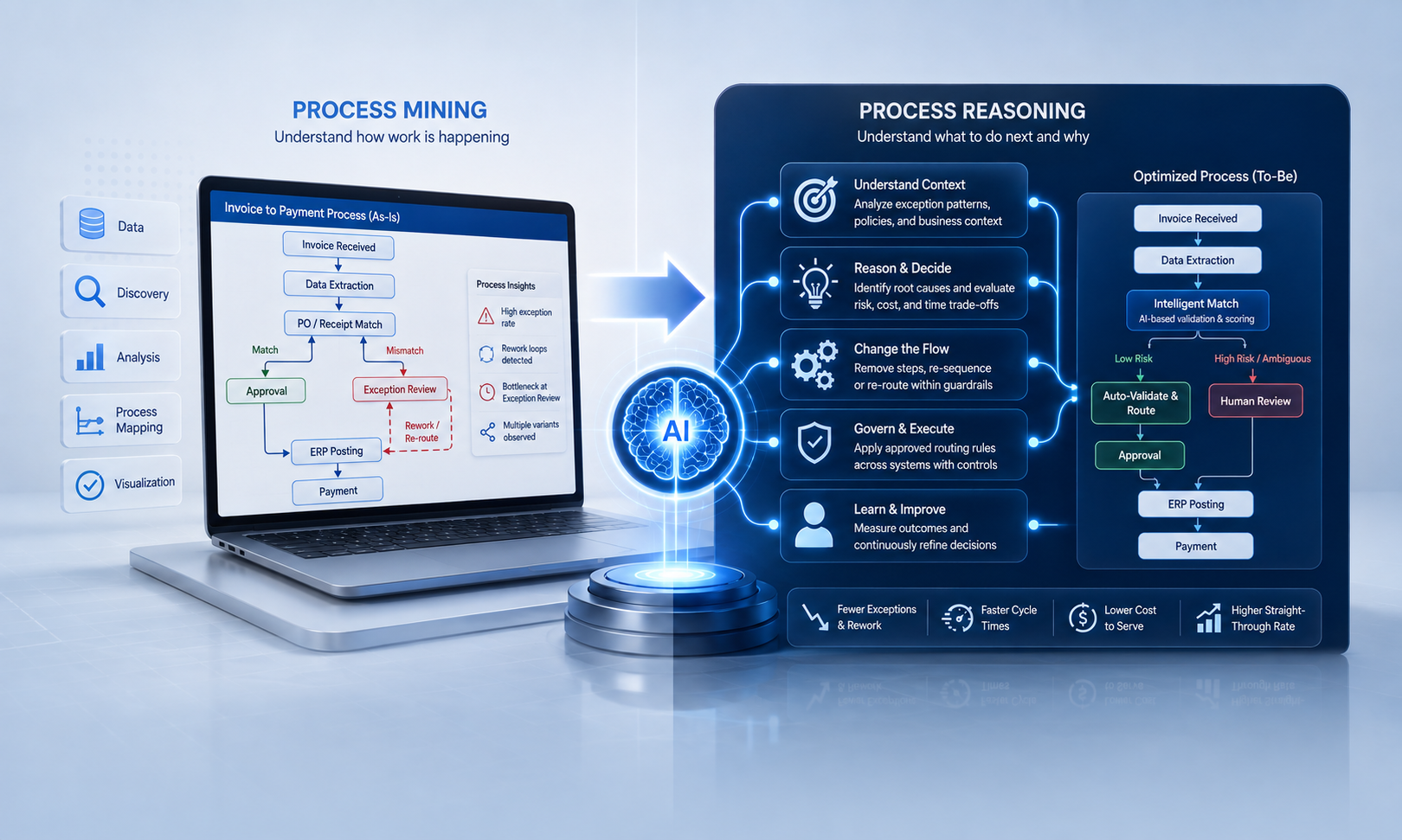
Process reasoning responds to that question. It shifts automation from passive observation to active interpretation and improvement. In 2026 enterprise environments, this capability increasingly powers agentic orchestration, where systems not only understand why events occur but operate within governed boundaries to adjust workflows autonomously.
This article breaks down the move from process mining to process reasoning. The sections ahead show the evolution path, technical architecture, and enterprise considerations for adopting reasoning-led hyper automation.
The evolution path: Mining → Prediction → Reasoning
Reasoning does not discard what came before; it layers new intelligence on top of it. Each stage builds on the previous one but expands capability in meaningful ways.
Process mining: Seeing the work
Process mining reads event logs and maps real workflows, including variants, bottlenecks, and gaps against ideal paths. The value lies in visibility, root-cause discovery, and data-backed prioritization of improvement projects.
Regardless, it is retrospective and static. Teams still schedule workshops, redesign flows, and raise change requests manually.
Process prediction: Anticipating trouble
Prediction adds forecasting to those maps. Machine learning spots likely delays, SLA breaches, or failures ahead of time. The value shifts from “what went wrong” to “what is likely to go wrong soon,” which lets operations teams reroute cases or add capacity in advance.
Yet these systems remain advisory; they send alerts and scores, but humans still rewire the process steps themselves.
Process reasoning: Changing the process
Process reasoning introduces a more causal and decision-centric capability. AI agents infer why certain paths cause delays or errors. Then recommend or implement structural adjustments to the workflow.
The key distinction: reasoning systems do not just change the dashboard; they change the process model, removing steps, resequencing tasks, or altering routing rules, within a governed envelope that defines what AI agents are permitted to modify.
What “process reasoning” means in practice
Process reasoning refers to a multi-layer, AI-driven causal analysis that identifies workflow issues, computes risk, cost, and time trade-offs, and introduces workflow optimizations with clear justification.
Reasoning differs from other automation approaches:
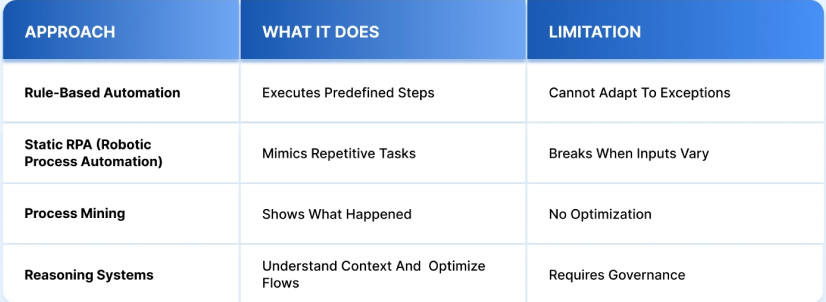
The benefit: enterprises gain workflows that are decision-aware, not just task-automated.
Technical architecture: How self-optimizing workflows are built
The automation becomes meaningful only when the underlying architecture supports reasoning, not just execution. That requires systems that read processes, interpret their intent, and adjust them with guardrails. Here’s what that architecture looks like in practice.
Core layers behind process reasoning
A reasoning system uses several coordinated layers. Each layer contributes to understanding, deciding, and adjusting.
-
→
Process mining layer: This layer ingests event logs, reconstructs flows, and monitors conformance, providing the objective and timestamped picture of how work actually runs
-
→
LLM reasoning layer: Large language models and other reasoning components interpret patterns, handle unstructured context, and generate proposed actions or workflow changes. They explain trends in business language, convert policies into executable rules, and design alternative sequences.
-
→
LLM reasoning layer: Large language models and other reasoning components interpret patterns, handle unstructured context, and generate proposed actions or workflow changes. They explain trends in business language, convert policies into executable rules, and design alternative sequences.
-
→
Reinforcement learning loop: Outcomes feed back into models to refine future decisions. Over time, the workflow becomes self-optimizing within the constraints leaders define.
The architecture is orchestration across systems — not a single tool. CXOs should ask how their platforms connect telemetry, reasoning, and execution rather than chasing yet another standalone tool.
Proof point: From insight to impact
A 2025 case study on end-to-end expense processing integrated generative AI, intelligent document processing, and an automation agent for a large Korean enterprise. The system handled receipt recognition, policy-based classification, intelligent exception handling, and human-in-the-loop approvals within a unified loop.
-
→
Processing time dropped by over 80 percent
-
→
Some flows moved from minutes to tens of seconds
-
→
Error rates fell
-
→
Compliance improved
-
→
Employees spent far less time on manual data entry
The gains came not only from OCR (Optical Character Recognition) or basic RPA but from an agent that learned from human judgments and improved how exceptions were routed and resolved. That reasoning-driven re-sequencing and exception handling is the same pattern enterprises can apply across claims, reconciliations, and underwriting.
For CXOs, this shows that reasoning-led hyper automation is not hypothetical. It already shrinks cycle times, reduces risk, improves decision consistency, and creates capacity for revenue-generating activities beyond cost efficiency alone.
Explainable optimization: Trusting autonomous change
Now, we know that AI can change workflows. But as autonomous changes increase, executives and auditors will want to know,“Why did the AI remove this validation step?” Trust grows only when every alteration, whether big or small, comes with a clear explanation.
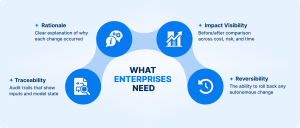
In practice, this means shifting from opaque AI adjustments to explainable optimization. That means, reasoning systems need to express their logic in human terms, such as “We removed step B for low-risk tier-1 customers because historical data shows no incremental risk and 25 percent faster resolution.” This blends quantitative impact (cycle-time, error rate) with qualitative rationale.
That clarity keeps autonomous change inside the governance framework and prevents black-box decisions from entering critical workflows.
Industry applications: Where process reasoning lands first
Once autonomous change becomes explainable and governed, the focus shifts to where it can drive meaningful outcomes. Certain enterprise workflows, especially those heavy on rules and exceptions, benefit much earlier from reasoning-driven automation.
BFSI operations and reconciliations:
In payments, settlements, and trade finance, reasoning agents can triage exceptions, auto-resolve routine breaks, and route only genuinely ambiguous cases to humans. Under explicit risk and compliance constraints, they also suggest step simplifications.
Claims processing in insurance and healthcare:
Claims journeys suffer from excessive handoffs and rework. Reasoning engines can cluster patterns of rework, recommend fewer touchpoints for low-risk claims, and ask for missing documents.
Treasury and reconciliation workflows:
Process reasoning can eliminate redundant checks for low-value, low-risk transactions while escalating cases with richer context bundles for humans.
Mortgage and credit underwriting:
Adaptive sequencing can decide which documents to request when, how to order checks, and when to escalate for manual review. That means fewer back-and-forth cycles with customers and more consistent credit decisions under policy.
Retail and supply chain optimization:
Reasoning engines can dynamically adjust replenishment cycles, re-route fulfillment paths, and reduce stock imbalances by interpreting real-time demand signals and operational constraints.
These use cases highlight where reasoning delivers fast wins. Yet applying it responsibly requires groundwork across data, teams, and guardrails. The next step is understanding what leaders must put in place.
Enterprise readiness: What leaders must get right
Process reasoning requires deliberate preparation. Leaders should validate capability in these areas.
-
→
Clean and high-quality event logs
-
→
Accurate decision metadata
-
→
Clear definitions of valid and invalid outcomes
-
→
IT, operations, and process excellence teams must co-own change
-
→
Experts validate AI-driven changes and provide corrective judgment
-
→
Continuous improvement
-
→
Guardrails define which changes AI can execute
-
→
Every change must be reversible with auditable lineage
-
→
Higher-risk workflows require tighter constraints
Throughput and SLA metrics give way to optimization metrics like:
-
→
From throughput → optimization effectiveness: Measure quality of improvement, not just volume
-
→
Track stability across agents, teams, and time.
From observing work to improving it
Process mining helped enterprises finally see their work as it truly happens, exposing the messy reality behind process maps. Process reasoning turns that visibility into action, allowing workflows to propose and test improvements within clear boundaries.
Hyper automation’s next phase will not be defined by more bots alone. It will belong to governed agentic systems that continuously refine enterprise workflows within defined risk boundaries, so operations improve autonomously, safely, and at scale.