
As a CXO in banking, insurance, or healthcare, you are no stranger to the trillion-dollar transactions and life-critical services your sector manages. Yet, why do so many organizations still cling to decades-old legacy systems that stifle innovation? In an era where AI is transforming industries, the intriguing question is: If AI can revitalize these regulated environments without a complete overhaul, why aren’t more leaders seizing this opportunity?
While some visionary companies are surging ahead, gaining market share, reducing costs, and enhancing compliance, others still risk walking the traditional path. Let’s explore why the lack of AI adoption is a missed opportunity and how early adopters are turning legacy challenges into competitive advantages.
The persistence of legacy systems creates profound barriers in the form of inflexible architectures that resist change, siloed data that obscures insights, delayed compliance updates that expose vulnerabilities, and poor integration leading to inefficient manual processes. These issues aren’t just technical. They are strategic liabilities in regulated sectors where precision and speed are paramount.
From legacy laggards to AI leaders: Questioning the status quo
In banking, why tolerate manual compliance checks that bottleneck operations when AI could enable real-time decisions? Insurance firms, how long will fragmented data undermine underwriting accuracy and profitability? And in healthcare, with human errors in diagnostics and high claim denials plaguing outcomes, isn’t it time to ask why AI isn’t standard for reducing risks under HIPAA and GDPR?
The evidence is striking: According to CIO Dive, businesses invested around $3 million in legacy upgrades in 2023, yet many still lag. Forward-thinking companies, however, are making the best out of AI implementation by layering it onto existing systems—automating tasks and fostering seamless data exchange. This isn’t about scrapping the legacy infrastructure, but enhancing it intelligently.
Those who adopt AI aren’t just complying; they are competing and achieving measurable gains. With proper governance and monitoring, AI turns legacy systems into agile assets. But the question remains: Why wait when competitors are already reaping the rewards?
Analyzing the facts: Why is AI adoption so uneven, and what are the costs?
Legacy systems’ limitations are well-documented, yet adoption gaps persist:
-
→
Rigid, isolated architectures slow unified data access and decision-making.
-
→
Manual processes delay compliance updates, creating operational risks.
-
→
Poor integration makes adding new services costly and prone to errors.
Data from the Software Improvement Group reveals that over 37% of financial systems on legacy architectures underperform, with updates 40% slower than modern ones. Without AI-driven modernization, banks could forfeit over US$57 billion in opportunities by 2028, particularly in payments revenue. Companies ignoring this are falling behind peers who integrate AI for faster, smarter operations.
This disparity extends beyond finance. In healthcare, the NHS’s outdated IT wastes millions of clinician hours due to fragmentation, with only 20% of organizations digitally transformed, per the Financial Times. Government AI initiatives in the UK are similarly hampered by legacy drag, as reported by The Guardian.
But some healthcare providers are already showing what’s possible. By using AI to connect legacy systems, they are freeing up clinicians’ time and improving patient care significantly. As a CXO, it’s worth asking – is your organization moving forward, or falling behind?
AI as the great equalizer: Why some companies are pulling ahead
AI implementation doesn’t demand a full system replacement. It makes use of the existing system, creating intelligent enhancements that drive competitiveness. Leaders in insurance, banking, and healthcare are adopting AI to outmaneuver rivals, questioning why others hesitate.
AI overlays for predictive analytics and automation
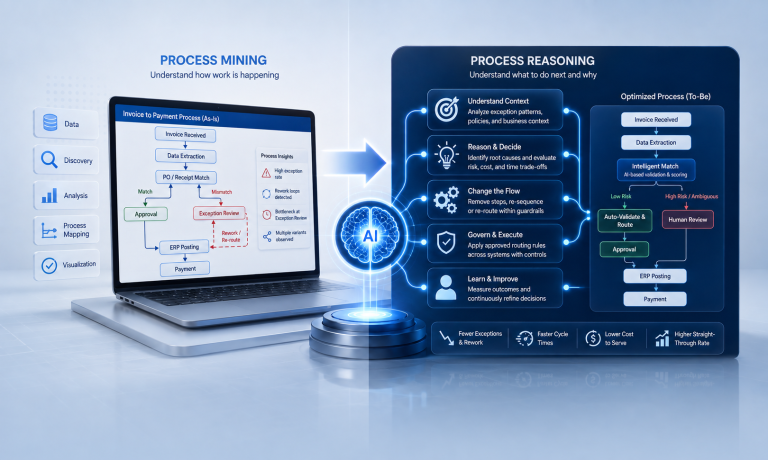
Progressive firms overlay AI on legacy systems to predict failures, automate routines, and deliver insights without disruption. This enhances efficiency and agility, while organizations that delay AI adoption remain constrained by outdated processes.
Natural language processing for unstructured data
Why leave vast unstructured data in emails and reports untapped? NLP turns it into actionable intelligence, boosting decisions and compliance. Companies leveraging this are gaining deeper insights faster than their peers.
AI-Driven interoperability across platforms
AI middleware bridges legacy and modern systems via smart APIs, enabling seamless integration. This is how forward-thinkers achieve the agility that the laggards envy.
Industry-Specific wins: How AI adopters are gaining competitive ground
Insurance
Why do some insurers settle claims in minutes while others take weeks? The difference is AI. By streamlining underwriting with machine learning, insurers can combine data, assess risk more accurately, and spot fraud faster. They automate compliance for solvency and audits, reducing errors and costs. Modor Intelligence study projects that the global AI in insurance market is projected to reach US$88.07 billion by 2030—those embracing it now are capturing market share, leaving hesitant competitors vulnerable to fraud and inefficiency.
Banking
In a sector demanding instant compliance and customer experiences, why settle for manual AML/KYC checks? Leading banks use AI for advanced credit scoring, real-time transaction monitoring, and compliant virtual assistants. RPA connects silos without replacement, saving billions. The Isenberg School of Management notes banks saved US$447 billion in 2023 via AI, with projections of US$1 trillion by 2030. Citi estimates an additional US$170 billion in profits over five years for adopters—proving why some institutions are dominating while others lag.
Healthcare
Data silos being the primary cause behind diagnostic errors and claim denials, why not use AI for computer vision in imaging, symptom-based triage, and predictive planning? Innovators ensure HIPAA/GDPR compliance through de-identification and secure analytics, while AI interoperability harmonizes EHRs for better care coordination. Techradar highlights the NHS App’s mere 16% integration coverage, but AI leaders are improving diagnostics and reducing risks, enhancing outcomes and efficiency over non-adopters.
A practical roadmap: Don’t let competitors outpace you
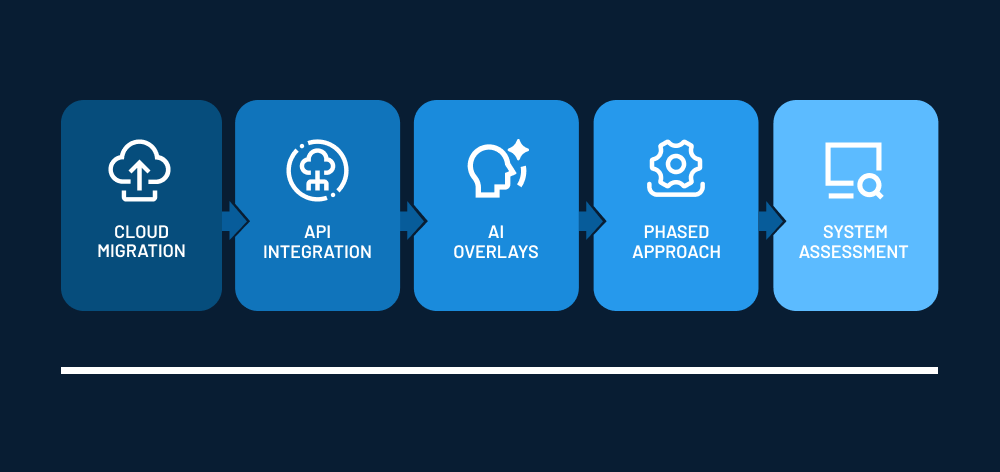
To join the leaders, follow a phased AI modernization strategy:
-
→
Cloud Migration: Boost scalability and security for a modern foundation.
-
→
API Integration: Securely link old and new systems.
-
→
AI Overlays: Add automation and analytics without upheaval.
-
→
Phased Approach: Minimize risks with incremental updates.
-
→
System Assessment: Evaluate risks and value first.
Success demands governance and maturity—CXOs at leading firms prioritize this to stay ahead.
Strategic AI adoption: Building compliance while gaining an edge
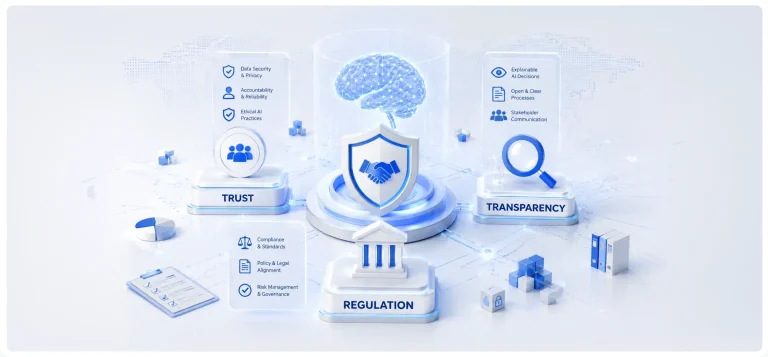
In regulated industries like BFSI and healthcare, AI strengthens oversight through continuous monitoring, automated reporting, and adherence to the EU AI Act, GDPR, and HIPAA. AI adopters explore and expand confidently, turning regulations into their advantage over slower rivals.
Turning legacy into leverage: Join the AI leaders today
Companies adopting AI are eliminating banking bottlenecks, sharpening insurance underwriting, and slashing healthcare errors. And not just increasing efficiency, but while upholding compliance. This isn’t just industry modernization, it’s a competitive imperative.
As a CXO, partner with experts who grasp your industry’s tech and regulatory nuances. At Flatworld.ai, we specialize in customized AI-first strategies that enhance without disrupting.