
CXOs, and AI/GenAI professionals beware, in the rapidly evolving field of artificial intelligence, many C-suite executives find themselves grappling with key concepts such as “AI Agents” and “Agentic AI” amid global transformation initiatives.
This confusion is widespread, as AI continues to disrupt industries at an unprecedented pace. According to MIT’s NANDA study, 95% of enterprise-grade AI projects don’t reach the production stage. This is often due to limited contextual learning and suboptimal implementation.
As AI strategists, our goal is to provide clarity on these distinctions, highlight effective approaches (and common pitfalls), and advise on whether to prioritize cutting-edge tools, established solutions, or a strategic combination. The answer lies in a balanced approach—one that’s firmed up with insights, data, and practical analogies.
Picture this: You’re at a high-stakes boardroom meeting, and someone’s pitching “Agentic AI” as the silver bullet for your supply chain woes. Meanwhile, your tech team is geeking out over “AI Agents” for customer service automation. Are they the same? Different? And more importantly, should you deploy the latest hype or proven winners? Maybe it’s time to unpack the “know-how “ to those that matter…
First things first: What are AI agents?
Let’s call out the truth; AI Agents are like the diligent interns of the AI world – autonomous software entities designed to perceive their environment, make decisions, and take actions to achieve specific goals. Think of them as digital butlers that don’t just respond to commands but proactively handle tasks.
-
→
Core Features: They use sensors (data inputs), actuators (actions like sending emails or updating databases), and a brain (algorithms) to operate. Examples include chatbots in customer support (e.g., IBM Watson Assistant) or robotic process automation (RPA) bots that handle invoice processing.
-
→
Real-World Wins: According to a McKinsey survey, companies deploying AI Agents in operations saw a 20-60% boost in efficiency. Take Amazon’s Sequoia warehouse robots – these agents navigate, pick, and pack with minimal human intervention, slashing fulfilment time by up to 25%.
But here’s the catch: Not all AI Agents are created equal. Simple ones (reactive agents) just respond to stimuli, like a thermostat adjusting temperature. Complex ones (deliberative or learning agents) plan ahead, learn from mistakes, and adapt. Think of Waymo’s self-driving cars, which have logged over 22 million autonomous miles and demonstrated up to 84% fewer serious crashes compared to human drivers (2024 data).
What doesn’t work? Overhyping basic agents as “transformative.” A 2024 Deloitte study found that 68% of organizations reported 70% of their experimental AI Agent deployments failed because they were shoehorned into unsuitable tasks. This can be like using a simple chatbot for nuanced legal advice. Result? Frustrated users and wasted budgets.
Now, enter agentic AI: The ambitious cousin
If AI Agents are the interns, Agentic AI is the ambitious entrepreneur – it’s all about agency. Coined in recent GenAI discussions (shoutout to pioneers like Andrew Ng), Agentic AI refers to systems that don’t just act but exhibit true autonomy, goal pursuit, and self-improvement. It’s AI with a “will” – capable of breaking down complex tasks, collaborating with other AIs, and even iterating on its own strategies.
-
→
Core Features: Built on large language models (LLMs) like GPT-4 or Claude, Agentic AI involves chains of agents working together. For instance, in a marketing campaign, one agent researches trends, another generates content, and a third analyzes performance – all without constant human oversight.
-
→
Real-World Wins: OpenAI’s recent experiments with agentic workflows show promise; Forrester’s TEI study of Quid found a 50% faster time-to-insight, enabling quicker decisions in analysis-heavy workflows. They’re powering fraud detection agentic systems, where one case study from a European bank reported a 40% reduction in false positives and 30% reduction in false negatives by letting AI “agents” autonomously investigate anomalies.
The excitement? Agentic AI is evolving rapidly. A 2025 projection from Modor Intelligence estimates that the market for agentic systems will hit $42.56 billion by 2030. But beware the pitfalls: What doesn’t work is deploying agentic AI in high-stakes, unregulated environments. An infamous 2023 clinical vignette study found that systematically biased AI models reduced clinician diagnostic accuracy by 11.3%. Moral: Agency without accountability is a recipe for chaos.
Spot the difference: Agents vs. agentic – A quick showdown
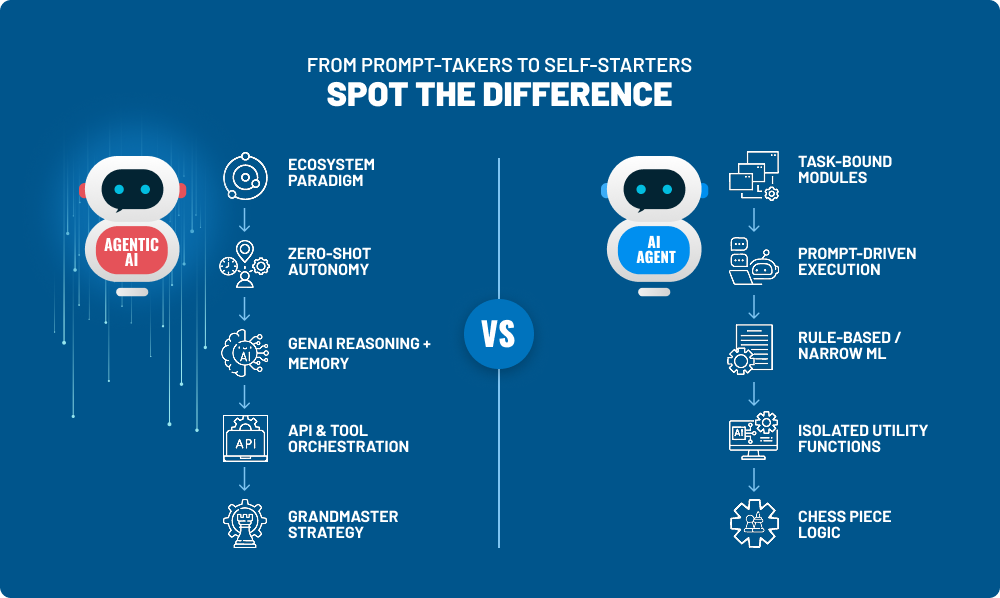
Okay, let’s clarify the confusion head-on. While the terms overlap (Agentic AI often uses AI Agents), they’re not identical:
-
→
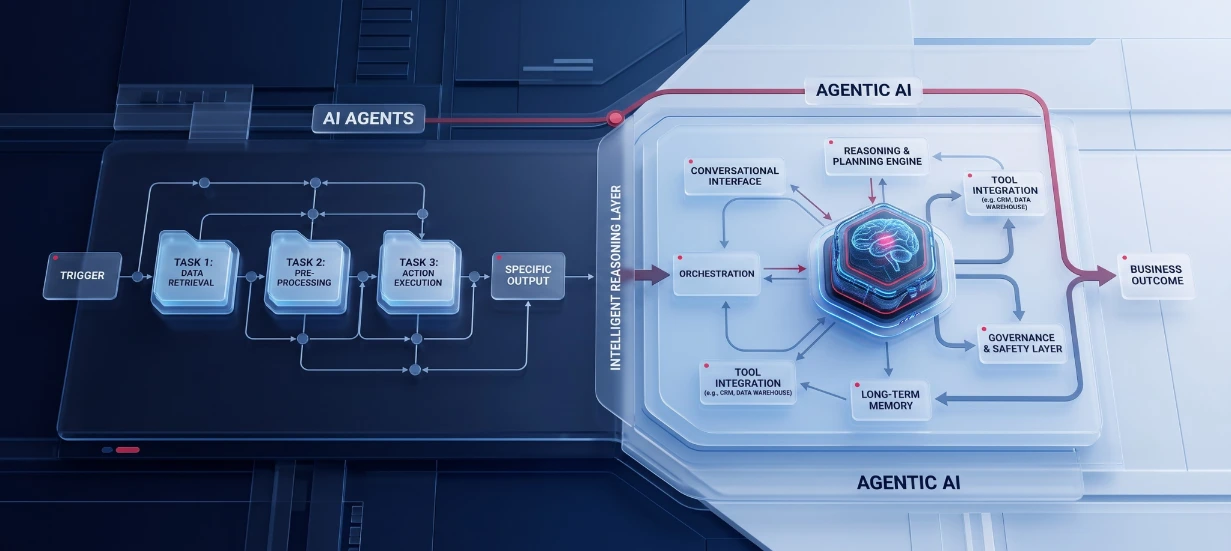
Scope: AI Agents are tools – modular, task-specific (e.g., a single agent booking flights). Agentic AI is a paradigm – holistic, where multiple agents form ecosystems to tackle multifaceted problems, like orchestrating an entire e-commerce overhaul.
-
→
Autonomy Level: Agents might need human prompts; Agentic AI strives for “zero-shot” independence, adapting on the fly. Analogy: An AI Agent is like a chess piece moving per rules; Agentic AI is the grandmaster strategizing the whole game.
-
→
Tech Stack: Agents rely on rule-based AI or basic ML. Agentic AI leverages GenAI for reasoning, memory, and tool integration (e.g., APIs for web scraping or database queries).
Data backs this up: A 2025 study, ‘Perceptions of Agentic AI in Organizations’ found frequent confusion among stakeholders between generative AI, AI agents, and agentic AI — with many misinterpreting the capabilities of each.
Successful deployments? Those blending them – like Microsoft’s Copilot, which uses agentic principles to empower agents in Office apps, boosting productivity by 29% in pilot programs.
What works: Hybrid models. What doesn’t: Treating them as plug-and-play. Berkeley/CMR and a systematic review of 84 AI projects found integration and contextual alignment to be the recurring failure points. However, studies support better performance and fewer failures in the case of hybrid models.
As AI evangelists, what do we suggest? A smart mix – Here’s why
We’re not here to sell snake oil. As evangelists, we advocate for a balanced portfolio: Blend the latest tools with proven solutions. Why?
Chasing the hype alone, such as untested agentic prototypes, might lead to stalled pilots: Gartner forecasts that over 40% of agentic AI projects will be scrapped by 2027 due to cost and unclear value.
So, leaning only on proven, older tech (like legacy RPA agents) risks falling behind. McKinsey’s research shows that agile, AI-driven companies deliver 2–6× higher total shareholder returns (TSR) than their slower peers. The real winners strike a balance—piloting emerging tools while scaling proven solutions that deliver measurable impact.
Our recommended recipe:
-
→
Start Proven: Anchor with reliable AI Agents for quick wins. E.g., RPA agents met or exceeded expectations in areas, such as accuracy, timeliness, and flexibility (per AI Multiple survey), perfect for CXOs seeking ROI in under 6 months.
-
→
Infuse Latest: Layer in Agentic AI for scale. Tools like Anthropic’s Claude or Hugging Face’s agent libraries are maturing fast – a PagerDuty study (about 1000 participants) predicts 86% of the companies will adopt agentic workflows by 2027, expecting more than 100% ROI.
-
→
Mix Magic: Combine them! In transformation projects, use agents for execution and agentic oversight for strategy. Case in point: Siemens’ global AI rollout mixed proven agents with agentic AI, increasing productivity by 50% across industrial/manufacturing setups.
According to a 2025 PwC survey, 79% of executives say their companies have already adopted AI agents, and of those, 66% report measurable value in productivity. Meanwhile, Blue Prism data shows 29% of organizations are using agentic AI already, with 44% planning implementation within the next 12 months.
However, many initiatives still stop short of full production; 69% of AI projects surveyed by Blue Prism are predicted to never make it into operational use.
So, what works: pilot small, iterate fast, and prioritize ethics/data governance. What doesn’t work: going “all-in” on unproven tech without training and infrastructure — many failures traced back to lack of governance, poor data quality, and insufficient capability building.
Ready steady go: Your AI adventure awaits
Those in the C-suite and those getting here, remember the AI landscape isn’t a battlefield of buzzwords – it’s an opportunity playground. Understand the nuances: AI Agents for tactical firepower, Agentic AI for strategic vision. Deploy a mix to future-proof your org, backed by data-driven caution. Business transformation is a great journey if accompanied by the right AI partner. Choose well, stay in the game!