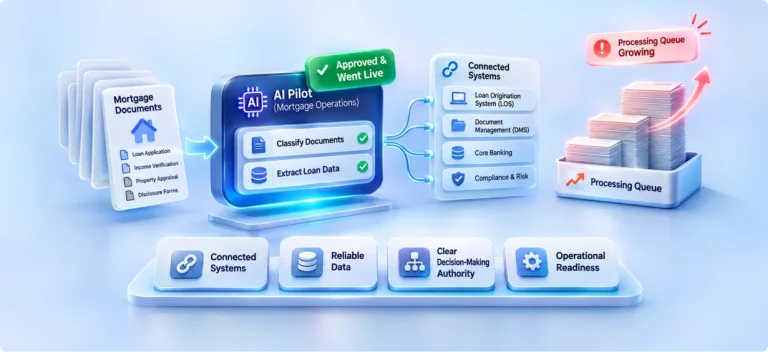

Mortgage lenders have too many automation options. Document classification, OCR, data extraction, automated underwriting, fraud checks, and workflow triggers can each remove manual work from loan processing.
But if you ask COOs and mortgage operations leader whether their turnaround times have improved or their exception queues have shrunk, you’ll definitely get a pause before the answer. Because the honest answer is usually “not as much as we expected.”
Lenders have adopted AI across their mortgage automation programs, but adding AI to individual activities does not automatically remove the bottleneck.
This is because mortgage origination is a dependency-heavy process. A document must be classified before its data can be extracted. Extracted data may need to be validated against other borrower information. Exceptions can stop downstream tasks. Underwriting decisions depend on complete documentation and applicable rules. Approved outputs must then reach the loan origination system (LOS) and the next team in sequence.
When those dependencies are not coordinated, the time saved on one task can be lost at the next handoff. So, the question worth asking is —
“Where does the process still break down between the parts we’ve automated?”
When task-level AI creates workflow-level bottlenecks
Let’s take an example of a lender that uses AI to classify incoming loan documents. The model can identify pay stubs, bank statements, tax forms, disclosures, and other documents.
That solves the classification task. It does not automatically resolve a missing bank statement, reconcile conflicting income information, update the LOS, route an exception, or inform an operations reviewer of the pending decision.
The same issue appears across the mortgage workflow.
-
→
Document Extraction Without Downstream Coordination: Extraction tools read text in isolation. They cannot cross-reference related documents, such as matching W-2 income to year-to-date pay stubs.
-
→
Underwriting Support Blind to Dependencies: An algorithm clears an asset condition. It fails to check if an updated earnest money deposit receipt is still missing.
-
→
LOS Updates Without Synchronized Workflow Execution: This creates gaps between what a system records and what an operations team needs to do next.
-
→
Unstructured Exception Routing: When OCR confidence scores dip below thresholds, files drop into unmonitored queues.
-
→
Human Reviewers Lacking Workflow Context: Processors receive isolated error flags without loan jacket details, forcing manual cross-screen investigation.
Task automation reaches its operational limit here. A lender can automate 10 activities and still have people coordinate the 11 handoffs between them.
The enterprise cost of fragmented mortgage automation
Higher application volume quickly exposes the hidden cost of fragmented mortgage automation.
The financial consequence is visible in production economics. According to MBA’s Chart of the Week analysis, the average cost to originate a loan in 2025 reached $16,320 for depositories and $12,209 for independent mortgage companies. Fulfillment activities, including processing, underwriting, and closing, still account for roughly 20% of that total, even after years of point-solution investment in mortgage loan processing automation.
Where does the bottleneck go
The bottleneck doesn’t disappear with fragmented automation. It shifts:
-
→
Stage-to-stage rework: Rework persists between the automated stage and the subsequent manual stage.
-
→
Ops as the integration layer: Operations teams end up serving as the integration layer, manually reconciling AI output with what the next system or person needs.
-
→
Exception queues as the real limit: Exception queues become the real constraint on throughput, regardless of how fast the upstream extraction runs.
-
→
Overhead that scales with volume: Scaling volume under this model increases coordination overhead rather than reducing it.
-
→
Fragmented visibility: Leadership loses a consistent view of where files are stalling, because each tool reports on its own slice of the process.
The architectural choice: Point automation or workflow execution?
This is the architectural choice every operations leader eventually faces with mortgage workflow automation.
The next stage of mortgage AI is coordinated execution across the full loan workflow, where automated loan processing workflows hand off to each other without manual coordination.
Five requirements for mortgage AI at enterprise scale
Mortgage AI architecture needs five operating controls.
Where ungoverned AI becomes a compliance risk
AI can handle routine mortgage processing, but certain decisions still require accountable human judgment. Ungoverned machine learning introduces severe compliance risks. Hallucinated income calculations or misclassified title commitments lead to unsaleable loans on the secondary market.
According to Fannie Mae, repurchases and indemnifications cost originators billions annually. That makes human governance an operating control, not a fallback for when AI fails.

When an AI system flags an income discrepancy, conflicting documentation, or an underwriting exception, the workflow should preserve the relevant context and route the issue to the appropriate reviewer.
The reviewer should have the source documents, extracted values, validation results, exception reason, and workflow history available at the point of decision. After the decision, the workflow should continue from that point without forcing the processor to rebuild the loan context.
This also matters for regulatory oversight. The Government Accountability Office notes that CFPB examinations of nonbank mortgage lenders can cover underwriting decisions, automated underwriting models, and policies governing those processes. It also notes that regulated lenders must oversee third-party service providers for compliance with federal consumer financial law.
What to evaluate before buying mortgage AI
Governance belongs in the operating architecture and must be part of vendor evaluation. Run any vendor proposal through these questions:
Any vendor proposal that can’t answer these directly is proposing another point tool.
MSuite: A governed execution layer for mortgage operations
MSuite is built around this workflow problem. It is a human-managed mortgage automation platform that integrates with existing LOS and IT systems. It combines document intelligence, workflow coordination, LOS-connected execution, exception handling, and human review inside one governed execution model.
MSuite connects to:
-
→
Document processing and validation
-
→
Underwriting support
-
→
Configurable workflow rules
-
→
LOS integration and synchronization
-
→
Human-governed exception handling
-
→
Operational visibility across the loan lifecycle
What the model looks like in practice
In one deployment, a leading US mortgage lender used MSuite to automate document indexing directly into their loan origination system. The deployment achieved:
The value came from integrating classification with LOS, queue management, exception handling, monitoring, and human review. That is what allowed the automation to operate inside the mortgage workflow.
What coordinated execution changes for mortgage operations
Based on various deployments by Flatworld.ai, lenders who move from point automation to governed execution have seen:
-
→
Fewer workflow bottlenecks: Loan processing time cut by 60%.
-
→
Reduced document-related rework: Document indexing and classification accuracy reaching 99%.
-
→
Faster movement between dependent stages: Indexing and data input speed up significantly.
-
→
More consistent exception handling: Indexing errors reduced by 80% through automated validation.
-
→
Less manual coordination across systems and teams: Time to sell a loan reduced by 20% via LOS-connected automation.
-
→
Greater processing capacity: Up to 5,000 loans processed per month on a single deployment.
-
→
Lower operating cost, better control: 45% in cost savings in one engagement.