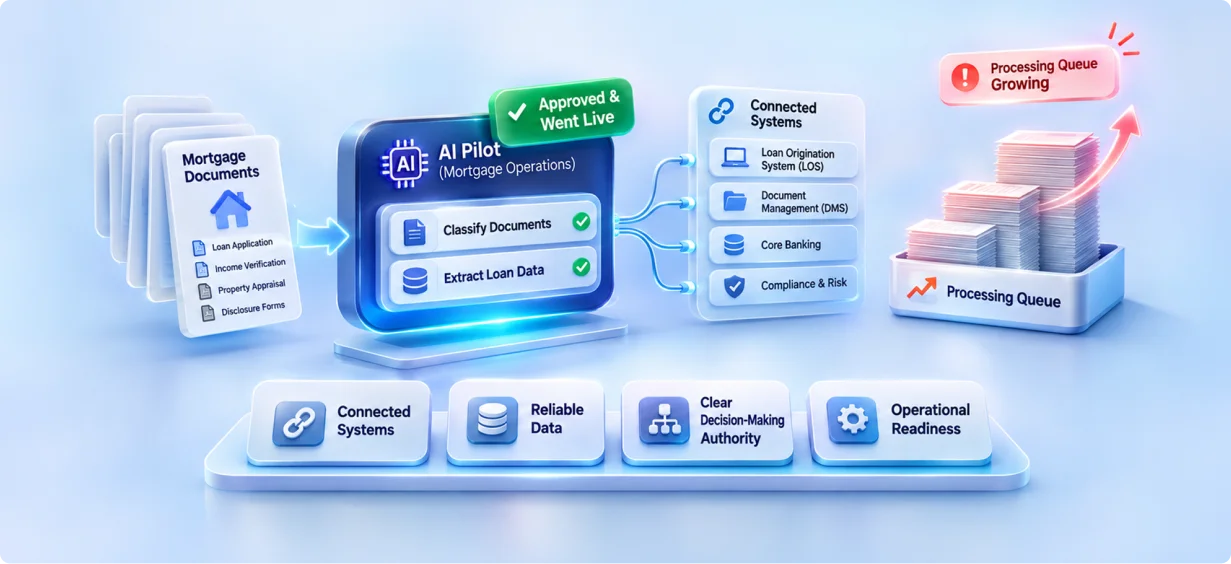

A mortgage operations team built an AI pilot to classify documents and extract loan data. The model classified forms, extracted loan data, and passed the pilot evaluation. It was even approved and went live. But reality strikes when the processing queue starts growing instead of shrinking.
This is where many enterprise AI adoption efforts run into trouble. The model can perform its job right. But the business needs connected systems, reliable data, clear decision-making authority, and people who know what to do when something goes wrong.
While a pilot may have validated the model, it’s the production that actually tests the operating model around it. This is a pattern we see repeat across enterprise AI rollouts, and it holds true well beyond mortgage processing.
The distinction helps explain a finding from MIT NANDA’s State of AI in Business 2025, published in Fortune. The research found that only 5% of the enterprise generative AI pilots that were studied delivered measurable P&L impact. This doesn’t mean 95% of models failed technically; it means they struggled to deliver real business value.
Let’s analyze a typical mortgage scenario where an AI pilot that appears successful can run into problems when it moves into a live workflow.
The live environment looked nothing like the test
The first challenge comes when the conditions around the model change.
During the pilot, the team works with a curated sample in a controlled environment. In production, the system has to handle the variety and inconsistency of real mortgage applications, including the exceptions experienced processors deal with every day.
Side by side, the two look like this:
The last row is where the difference becomes clear. The pilot establishes whether the model could classify documents and extract loan data. But the production has to establish whether the system can help process loans faster, maintain quality and compliance, and control cost per loan.
Accuracy is important, but so are processing time, cost per loan, compliance, throughput, and exception rates. The original evaluation did not establish whether the system could deliver those outcomes under production conditions.
Data extracted doesn’t integrate with downstream systems
Once the model adapts to the incoming documents and continues extracting loan details, the files should move to the next step. However, they remain in the queue because the extracted fields do not flow cleanly into the loan origination system.
Borrower information needed for processing is still spread across other systems, and the team has to manually validate and re-enter data. The team has automated a task without connecting it to the rest of the workflow.
This is a recurring AI pilot-to-production challenge. An AI system can handle one step efficiently while the surrounding process remains unchanged. Manual handoffs, disconnected applications, and incompatible data formats then become the bottleneck.
Integration should ensure output reaches the right destination in the right format, passes the necessary validation checks, and triggers the next action. Otherwise, the operations team ends up doing the coordination that the system was supposed to reduce.
AI can’t tell when a loan file was complete
Once the integration gaps are addressed, the mortgage team expects the queue to move faster. But instead, files start coming back from quality checks.
The extracted figures are correct, but some files fail investor overlays, closing conditions, or internal checklist requirements. Experienced processors know which rules apply to each case. What happened is that the model has learned to read the documents, but not to determine whether the entire file is ready to proceed.
This is where operational grounding becomes essential.
A mortgage workflow depends on business rules, standard operating procedures, policy thresholds, dependencies between steps, and defined exception paths. Those rules may sit in different systems or exist only in the experience of the people processing the loans.
Without access to the relevant context, the model can’t tell whether a case is complete. Data readiness is critical too. Even a well-instructed model will struggle if borrower records, policy requirements, and workflow instructions remain disconnected.
The team begins encoding more of these rules into the workflow. That reduces some rework, but it also raises a question about which decisions the AI could make on its own.
AI doesn’t understand decision rights and escalation
The next step makes another gap clearer. The system approves a document set that should have gone to an underwriter. In parallel, a reviewer spends two days checking routine outputs that posed little risk and could have been handled by AI.
The problem is that nobody defined decision rights or review triggers before deployment: who, or what, has the authority to decide, and when a human needs to step in.
In the mortgage workflow, the system can automatically validate routine document classifications, while ambiguous extractions and policy-sensitive cases go to a reviewer.
Once the reviewer decides, the workflow resumes, with the outcome recorded for future reference, the exact control that would have caught the underwriting error in this scenario, without requiring anyone to inspect every routine output.
These controls are built into the system as agentic AI takes on more actions across enterprise systems.
When the model is wrong, who owns the outcome?
At this point, the team discovers that the AI has wrongly extracted a piece of loan information, and the error made it into the documents prepared for closing.
The data science team says the model has performed within its agreed tolerance. But operations says the system was never properly configured on their end. The error was eventually corrected, but it’s unclear who is responsible for preventing it from happening again.
In a pilot, the project team handles issues. In production, enterprise ownership means assigning a control authority to resolve errors, approve changes, and decide when a workflow needs to stop.
Technical teams may own model performance, but the business remains accountable for operational outcomes. Without clear ownership, errors pass between teams and fixes take longer.
Production data didn’t stay like the pilot’s
The mortgage team in our pilot improves its rules and review checkpoints, but nobody monitors how changes to forms and policies might affect the model.
When the lender updates a key form or changes its policies, the AI system struggles with documents it previously handled well. A policy update changes the conditions that applied to certain loan types. The system continues processing files, but confidence scores gradually go down. Exceptions accumulate before anyone investigates the change.
This is inference drift, where production inputs or conditions move away from those represented in the original evaluation. New document formats, upstream system changes, revised prompts, and modified business rules can all affect output quality.
This means a model that had passed the initial round of evaluation can become less reliable without a big failure or outage.
We’ve seen the same pattern play out in healthcare revenue cycle operations, where inference drift quietly erodes claims accuracy long before anyone notices a failure.
Production monitoring needs to track performance across document types and workflow stages, including accuracy, confidence, and exception rates. Thresholds should trigger investigation, and named owners must be responsible for deciding whether the response requires updated rules, additional evaluation, or changes to the model.
Continuous improvement also means re-evaluating the system when forms, policies, or connected applications change. Without that discipline, the business continues relying on performance results that no longer reflect live conditions.
Scaling exposed everything the pilot hid
As the mortgage operation scales in the pilot, the earlier weaknesses become harder to contain.
-
→
Exception backlog: Exception queues grow faster than the team can clear them.
-
→
Integration debt: Integration gaps repeat across every system of record the workflow touches.
-
→
Shadow work: Shadow manual work expands as staff check outputs and complete handoffs the AI could not.
-
→
Cost unpredictability: Costs become harder to forecast as AI-driven exceptions scale.
This is the post-pilot cliff in action: the point where manual workarounds that worked fine in a small pilot collapse under real production volume.
According to CIO Dive, an S&P Global Market Intelligence survey found that 42% of companies abandoned most of their AI initiatives in 2025, up from 17% the year before. Organizations had scrapped an average of 46% of their AI proofs of concept before production.
Before expanding the mortgage rollout, the team needs to confirm the workflow can handle realistic production volumes: testing throughput, exception rates, integration reliability, and cost per loan at scale.
The production readiness test for enterprise AI pilots
To avoid failures and ensure readiness, ask these questions before rolling out enterprise AI solutions:
-
→
Integration: Can validated outputs reach the next step and the relevant systems of record without manual re-entry?
-
→
Operational grounding: Does the AI have the business rules, SOPs, and exception paths needed to process a case correctly?
-
→
Governance: Are permissions, decision boundaries, and escalation paths documented?
-
→
Human oversight: Which outputs require review, and what triggers a HITL checkpoint?
-
→
Enterprise ownership: Who is accountable when an output is wrong, or a workflow fails?
-
→
Evaluation: How will production monitoring detect drift, and who acts when performance declines?
-
→
Scale: What happens to cost per loan, throughput, and exception volume at ten times the pilot volume?
Any question left unanswered points to a gap in the operating model, and that gap gets more expensive to fix as volume grows.
Building the operating model around the AI
In most of the AI deployments that have failed, production has exposed gaps like disconnected systems, missing rules, unclear decision boundaries, weak ownership, and inadequate monitoring that kept the business from turning technical performance into a dependable result.
That is the central challenge behind moving an AI pilot to production. Model capability matters, but the operating model determines whether that capability translates into business value.
Flatworld.ai approaches enterprise workflows through a diagnose, deploy, and govern model. Our personalized process agents are configured around client-specific workflow logic, including the rules that determine when a case is complete. Human reviewers retain responsibility for judgment calls, exceptions, and approvals, supported by role-based access, review checkpoints, and audit trails.
The approach focuses on putting AI to work within live operations, with the surrounding processes and controls needed to support reliable execution.