
Over the past few years, customer operations conversations in most enterprises have largely centered on AI deployment and the promise of AI-powered customer operations. Enterprises have chosen platforms, launched pilots, expanded into new channels, and put conversational tools in front of customers and agents.
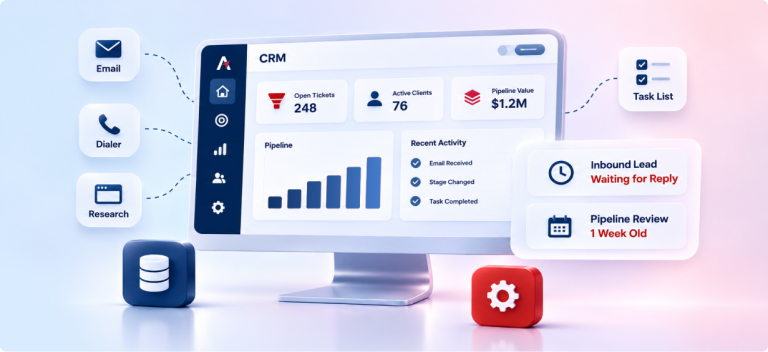
Yet many of these deployments have improved the interaction layer without changing how the underlying work gets completed. Processes can remain fragmented, leaving employees to manage system handoffs, make decisions, complete transactions, and coordinate follow-up work manually.
The customer operations gap AI hasn’t closed
Customer operations leaders have seen what AI can do with language: answer questions, summarize conversations, retrieve information, recommend responses, and help agents work through cases faster.
The more consequential issue is what happens between understanding intent and delivering resolution. A customer may ask to change an order, dispute a charge, or resolve a recurring issue: each requiring the operation to pull information from different systems, apply policy, secure approval, coordinate across teams, and record the outcome.
Every unresolved handoff, avoidable escalation, repeated agent action, and delayed decision carries an operational cost: longer resolution cycles, higher cost-to-serve, constrained agent capacity, and inconsistency in the customer experience.
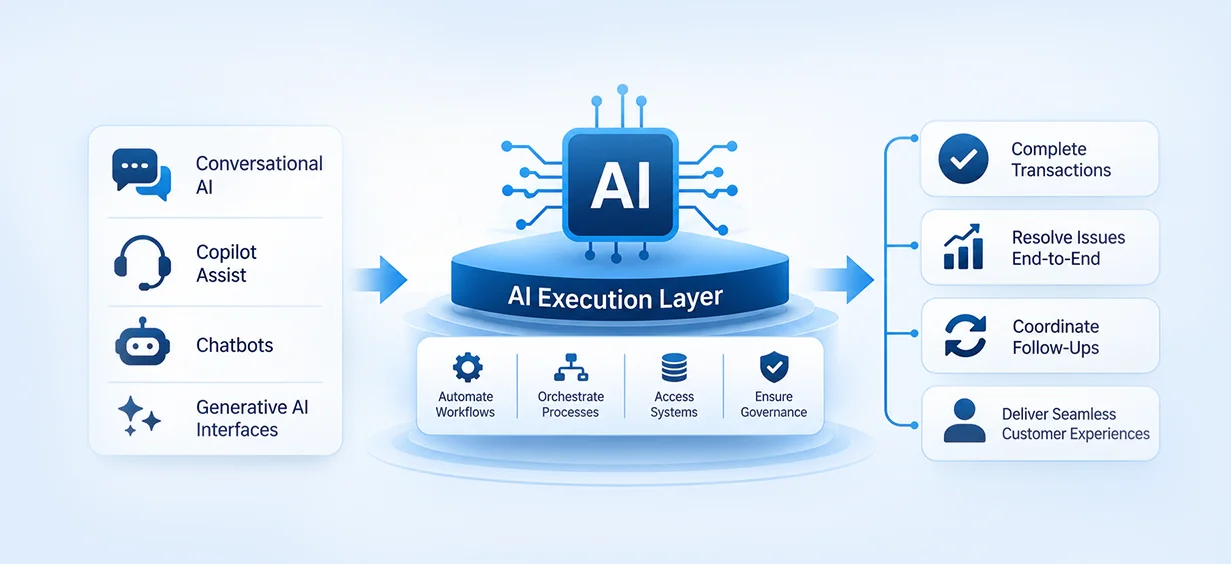
The next phase of enterprise AI requires a shift in emphasis: from systems that interpret and assist to an AI execution layer for customer operations, capable of coordinating decisions, initiating authorized actions, managing exceptions, and carrying accountability through to resolution.
The shift from AI assistance to operational execution
AI in customer operations has evolved through three distinct tiers. The difference is evident when the technologies are considered by their operational roles.
An AI execution layer connects customer intent with the operational systems and processes required to complete the request. It interprets the request, gathers relevant context, determines the permitted next step, interacts with connected systems, and keeps the workflow moving. When the request exceeds its authority or confidence, it routes the work to an appropriate human while preserving context.
The implications grow as enterprises scale AI across increasingly complex operations. McKinsey reported that 41% of AI deployments in customer-facing functions had fully scaled, making them 3.5 times more likely to reach scale than AI deployments in other business domains.
Where customer requests become operationally complex
A request that sounds simple to the customer can represent a complex operational chain inside the enterprise. Each handoff introduces another dependency and another potential break in context.
Cross-system handoffs
A service request may begin in chat, require information from a CRM, trigger an action in an order platform, and end with a status update in the ticketing system. Every handoff is another opportunity for delay or lost context.
Ticket-to-resolution gaps
A ticket being “answered” and a ticket being “resolved” are not the same event, but most reporting treats them as one, so response-time dashboards can look healthier than the operation actually is.
Repetitive agent actions
Teams spend substantial time on work surrounding the conversation, such as account lookups, status checks, data entry, routing, documentation, and follow-ups that consume capacity even when the underlying decision is straightforward. This is the work customer service workflow automation should absorb first.
Channel fragmentation
A customer who starts in chat and follows up by phone has to re-explain the issue because context doesn’t carry over between channels.
Exceptions and approvals
Anything outside standard policy, be it a goodwill credit or a manual override, tends to be low volume but requires close attention, and often stalls in an approval queue with no clear ownership or SLA.
Context lost during escalation
When a case reaches a human agent, it frequently arrives stripped of the history that would let them resolve it on the first attempt.
Among service organizations, adoption of AI agents for customer service jumped from 39% in 2025 to 66% in 2026: a 1.7x increase in a single year, according to Salesforce’s State of Service: AI Agents Edition report. Deploying AI is becoming easier. The harder part is putting it to work across the systems, handoffs, and decisions that still require human intervention.
What must an AI execution layer do?
Before evaluating customer operations automation solutions, leaders should have clear answers to seven questions: not about generic AI capability, but about what happens when a request touches three systems, an ambiguous policy, and a tight deadline at once.
Understand intent and operational context
It must work out what has actually happened in the account: order history, recent tickets, loyalty tier, and regional policy using live CRM, order, and billing data, not just the conversation.
Coordinate workflows across systems
Most requests aren’t a single step. A refund might touch the order platform, payment gateway, and case-management tool in sequence, calling each in order, holding state between calls, and knowing what to do if one fails partway through.
Execute permitted actions
Reading data is low risk; writing to a production system is not. Here an execution layer behaves like a limited-permission employee, acting only within a scope defined in advance, enforced through role-based access and a record of what changed.
Preserve context across channels
A customer who explains an issue in chat and then calls shouldn’t have to repeat it, which requires one persistent case view across chat, voice, and email, not separate histories per platform.
Route exceptions intelligently
No policy covers every situation, so the system needs a confidence threshold and defined exception categories such as goodwill requests and disputed charges, flagging what it shouldn’t touch rather than attempting it anyway.
Preserve human authority
Large financial exposure, policy exceptions, and vulnerable-customer cases need a person in the loop, decided in advance, not discovered after something has gone wrong.
Track execution and operational outcomes
Every action needs a record: what it did, which systems it touched, why, and where it stopped if incomplete. That’s enough for compliance to reconstruct a decision later and for the organization to trust the system.
A customer request, end to end
Consider a customer who messages: “Can you confirm my recent order and what I still owe, and tell me when it’ll arrive?” A chatbot can explain the delivery policy. A copilot can help an agent look up the order and draft a reply.
An execution layer does the work itself:
-
→
Verifies the customer’s identity
-
→
Checks delivery status and flags exceptions for late shipment
-
→
Confirms payment status and surfaces compliant payment options if unpaid
-
→
Assembles the answer and updates the record — faster than a human would finish reading the ticket
If the request qualifies for an approved resolution, the system acts directly. If it falls outside policy, such as a disputed charge, it escalates to a human with the evidence already attached.
The governance question: How much should AI be allowed to execute?
Every execution layer runs into the same question: which decisions can the system make on its own, and which need a person to sign off first? A mature execution architecture sets explicit boundaries across six areas:
-
→
Decision rights: What the system can decide alone versus only suggest.
-
→
Confidence thresholds: How certain it must be before acting: too low risks bad guesses, too high wastes the automation.
-
→
Approval rules: Which actions need human sign-off regardless of confidence: large amounts, contract changes, anything hard to undo.
-
→
Reversibility: Whether an action can be undone if later judged wrong.
-
→
Auditability: Whether the organization can reconstruct, after the fact, what happened and why.
-
→
Human oversight: Whether a person can step in before, during, or after execution, not only after something has gone wrong.
This matters most when execution touches financial transactions, customer entitlements, account access, regulatory obligations, or other sensitive processes. The objective is controlled automation at the points where the business can accept the associated decision risk.
Gartner projects that by 2029, agentic AI for customer service will autonomously resolve 80% of common issues without human intervention, cutting operational costs by roughly 30%. That trajectory only holds if governance scales alongside execution authority; autonomy without a decision-rights framework is simply risk deferred to a later, more expensive quarter.
Evaluate AI through operational performance
Chatbot-era metrics: deflection rate, first-response time, and CSAT measure the conversation, not the resolution of the underlying request. Customer operations leaders evaluating an execution layer should shift the scorecard toward:
-
→
Resolution rate: The share of requests fully completed, not just responded to.
-
→
Cycle time: How long a request takes from first contact to confirmed resolution.
-
→
Escalation rate: How often, and how cleanly, cases move to a human.
-
→
Automation rate: The share of eligible workflows completed without manual intervention.
-
→
Consistency: Variance in outcomes for similar requests, a proxy for compliance risk.
-
→
Cost-to-serve: Fully loaded cost per resolved request, not per ticket touched.
-
→
Customer outcomes: Retention, repeat contact rate, and satisfaction tied to resolution.
Evaluate an execution layer for your customer operations
Before any demo, a short internal checklist keeps the evaluation grounded in operations:
-
→
System reach: Can it act across the systems your teams already use, or only within its own interface?
-
→
Request coordination: Can it coordinate a multi-step request, not just a single-turn answer?
-
→
Exception routing: How does it identify and route exceptions, and how fast?
-
→
Context continuity: Does context survive a channel switch or a handoff to a human?
-
→
Escalation evidence: What evidence does it provide a human agent at escalation?
-
→
Configurable authority: Can decision rights and confidence thresholds be configured, not just toggled on or off?
-
→
Execution visibility: Can you see, after the fact, exactly what it executed and why?
Where Telenok fits
Telenok, Flatworld.ai’s agentic AI execution layer for customer operations, is built around this operational anatomy. It connects customer engagement, workflow execution, and system actions, resolving eligible requests independently and escalating exceptions to human agents with full context and a recommended next step, all within configurable governance controls.
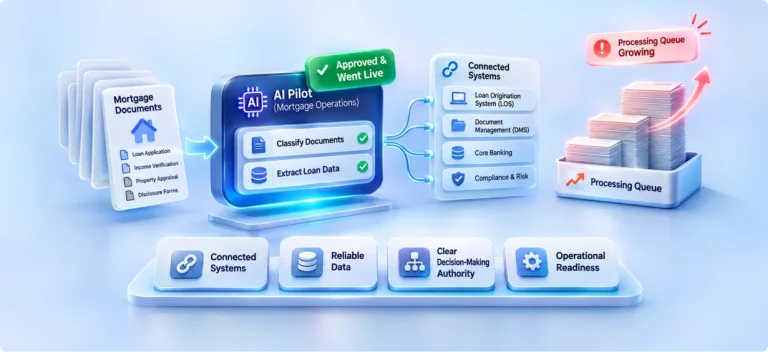
The pattern holds up outside the whiteboard. A U.S. mortgage services firm deployed Telenok to handle loan program questions that previously required loan officers to manually search through static documents. The result: an 80% faster response time on common borrower queries, a 3x increase in lead conversion tied to faster turnaround, and a 40% improvement in borrower satisfaction scores.