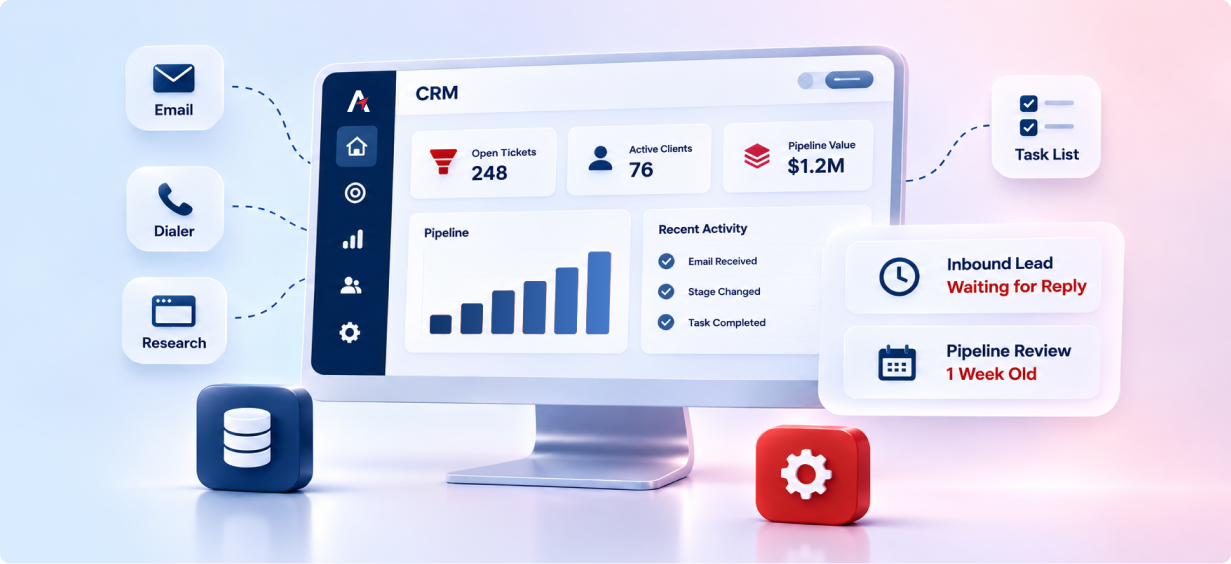

Many sales teams run a fully deployed CRM, ensuring every opportunity has an owner and a stage. Yet inbound leads still wait hours for a first reply, and the weekly pipeline review relies on data that is already a week old.
The usual conclusion is that the CRM has failed. But has it? The CRM records outcomes, but the daily work of deciding what to act on, replying, calling, following up, and logging it all happens in email, a dialer, research tabs, and task lists. Most CRM workflow automation falls short in the gap between the record and the actual work.
According to Salesforce, reps spend only 40% of their week actually selling, and 42% say they feel overwhelmed by the number of tools they use.
Where sales execution breaks around the CRM
Let’s take a typical inbound lead. It lands in the CRM with all the right fields. But which lead a rep works first is decided based on instinct and whatever looks urgent that morning.
The reply is drafted in email, away from the deal history. The discovery call happens in a separate dialer and gets logged that evening, or not at all. The follow-up depends on a reminder the rep has set, or remembered to set. By the time a rep updates the stage, the record is already days behind. According to Validity, 76% of organizations say less than half of their CRM data is accurate and complete.
Sales playbooks also have a problem. According to Bain & Company, about 70% of companies do not effectively integrate their sales plays into CRM and revenue technologies. The result: the strategy leadership signs off on rarely reaches the rep’s day.
None of this means the CRM cannot automate. Modern CRMs handle rules, sequences, and task triggers well. What they seldom do is coordinate the next action across the tools reps actually work in.
The cost of treating an execution gap as a CRM problem
Leaders usually respond to the gap in three concrete ways, and the first two cost more than they appear.
-
→
Replace the CRM: Moving to a new CRM keeps RevOps and IT busy for months, and pipeline history, reports and integrations get lost along the way. According to Gartner, only 11% of sales organizations kept commercial results on track while transforming. If reps keep working in email and the dialer afterward, the new system inherits the gap from the old system.
-
→
Add point tools: An engagement platform, then a dialer, then an AI writing assistant. Each one fixes a single step, and the rep becomes the integration between them. Gartner’s 2024 seller survey found that sellers who feel overwhelmed by the technology their job requires are 45% less likely to attain quota. Seat costs increase with every tool and every hire, while leadership still cannot see where deals are getting stalled.
-
→
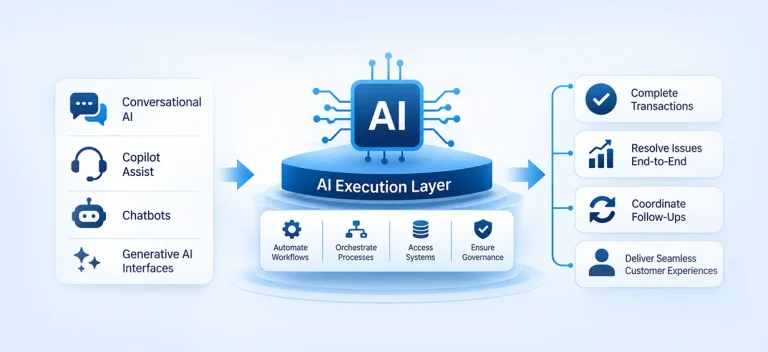
Add an execution layer: The CRM does the record. Reps get one workspace where the next action is ranked, prepared, and logged back. This is the kind of work enterprise AI solutions take on, with AI operating inside existing systems instead of replacing them.
Some teams also consider building a custom AI layer in-house. That raises governance, security, compliance, and ongoing model-cost questions most sales organizations are not staffed to answer. Constellation Research advises extending proven platforms rather than building CRM capability from scratch.
Does an AI sales execution layer replace a CRM?
No. An execution layer runs alongside the CRM, which keeps handling reporting and forecasting. Keeping the CRM can be the end state. It can also be the starting point for consolidating tools, once the team has evidence that adoption is real.
That means a 90-day run with clear measures: response speed, follow-up coverage, activity completion, time saved, and the number of tools retired.
When the platform supports migration from systems like Salesforce, HubSpot or Zoho, consolidation becomes an option the business can choose, instead of a project it is forced into.
What Should You Check Before Implementing AI Sales Automation?
Gartner’s research on technology as a teammate found that 49% of sellers are overwhelmed by the technology their job requires. These questions are worth taking into the next vendor call or budget review:
SalesDen, the AI Sales execution platform for teams with a CRM
The gap isn’t a CRM problem. It’s that daily execution happens somewhere the CRM can’t see. SalesDen, part of Flatworld.ai’s suite of enterprise AI products, is built to sit in that gap: it works alongside the existing CRM, communication, and sales systems as the layer where daily sales execution actually happens. The CRM keeps the record; SalesDen coordinates the next action.
A rep’s day starts from a ranked queue instead of guesswork. Email and proposal drafts are built from deal context, but a rep still reviews everything before it goes out. Calls run in the same workspace, with transcription and summaries captured automatically, and follow-ups surface on their own instead of depending on memory. Activity logs back to the CRM as the work happens, not at the end of the day.
On cost and control: unlimited users with no per-seat licensing, self-hosted deployment, and a standard rollout of about four weeks. Flatworld built SalesDen for its own sales operation first, which runs on it to handle more than 10,000 leads a year.
SalesDen as the AI sales execution platform works on top of your existing CRM, with the option to become the system of record later if consolidation makes business sense. This phased approach keeps adoption low-risk and preserves flexibility as your sales operations evolve.
What changes when execution has a layer of its own
The weekly pipeline review is usually the first thing to change. First responses come faster, and follow-ups stop depending on memory. Because activity is captured as work happens, the CRM stays current as a by-product of selling.
That sets up a loop. As more daily work moves into the layer, the record becomes more accurate, prioritization gets sharper, and reps have more reason to work there. Constellation Research points to this cycle between adoption and data quality as the main payoff of treating CRM as a system of action.
Fewer tools sit in the daily path, growth carries no seat-cost penalty, and the CRM investment and leadership reporting stay intact.